Going Off Half-Cocked
The Definition
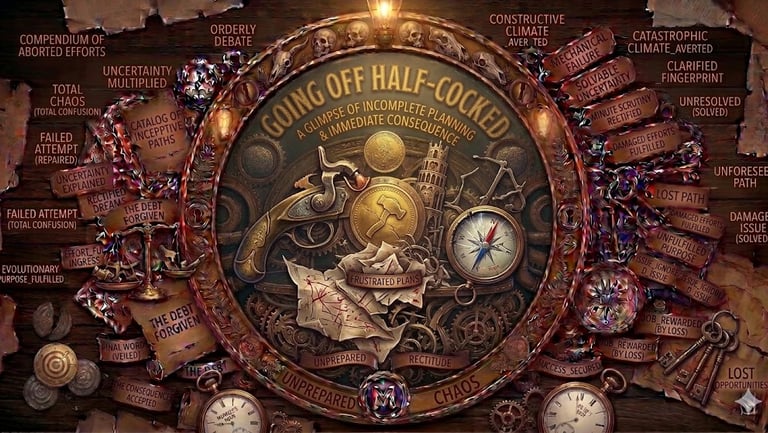
To "go off half-cocked" means to take sudden, aggressive action, speak rashly, or launch a major project before you are fully prepared, properly informed, or properly equipped. It signifies an impulsive, premature outburst that frequently results in a spectacular, self-inflicted failure due to a complete lack of deliberation.
The Deep Dive
The phrase is a direct, literal carryover from the hazardous world of 18th-century black-powder firearms—specifically the mechanics of the flintlock musket and pistol.
The Anatomy of the Lock: To understand the phrase, you have to look at the firing mechanism (the "lock") of a flintlock weapon. The hammer that holds the piece of flint is called the cock. This hammer has three distinct physical positions or settings when pulled back by the shooter:
Uncocked (Down): Resting flat against the battery; completely safe but incapable of firing.
Half-Cock: The hammer is pulled halfway back into a deep, mechanical safety notch. In this position, the trigger is locked and completely immobilized, allowing the soldier to safely open the pan and pour in the gunpowder without fear of the gun firing accidentally while loading.
Full-Cock: The hammer is pulled all the way back, fully compressing the internal mainspring. The weapon is now live, highly sensitive, and ready to fire the instant the trigger is pulled.
The Mechanical Failure: Over time, through the intense vibration and grime of battlefield use, the delicate iron safety notch on the half-cock setting would become worn down, chipped, or stripped. If a soldier jammed their weapon into a holster or knocked it against their gear while it was set to half-cock, the internal sear could slip right past the broken safety notch. The hammer would slam forward prematurely, striking the steel spark-producer (the frizzen) and igniting the gunpowder right in the soldier's hands or pocket.
The Battlefield Hazard: A musket "going off half-cocked" was a military disaster. At best, it startled the entire line, wasted precious ammunition, and ruined the tactical element of surprise. At worst, because the soldier hadn't finished packing the heavy lead ball down the barrel with their ramrod, the premature explosion would merely flash out of the touchhole, burning the soldier's face and hands while leaving the gun completely useless.
The Linguistic Mutation: By the early 1800’s, as the idiom jumped into American frontier slang, the phrase shed its gunpowder soot. It transformed from a literal mechanical malfunction into a character assessment. It became the premier metaphor for an hot-headed individual who "fires off" their mouth or launches an enterprise before checking their facts, ensuring that their effort fizzles out before it ever has a chance to hit the target.
Fast Facts
The "Flash in the Pan" Cousin: This idiom is a close relative to another flintlock phrase: "a flash in the pan." That occurs when the powder in the external pan ignites with a brilliant flash, but fails to pass through the touchhole to ignite the main charge inside the barrel—resulting in a lot of noise and smoke but zero actual impact.
The Constitutional Evolution: The mechanical safety feature of the "half-cock" position is the direct linguistic ancestor to our modern firearms safety levers and buttons, marking the earliest institutional attempt to build mechanical accident-prevention into personal weaponry.
References
Smyth, W. H. (1867). The Sailor's Word-Book: An Alphabetical Digest of Nautical Terms. Blackie and Son. (Documenting the crossover of small-arms jargon into naval and colloquial speech).
Ammer, C. (2013). The Dictionary of Clichés. Skyhorse Publishing.
Oxford English Dictionary. (2026). The Mechanical Nomenclature of Early Modern Ballistics and the Proliferation of Frontier Metaphors.