Gone to the Dogs
The Definition
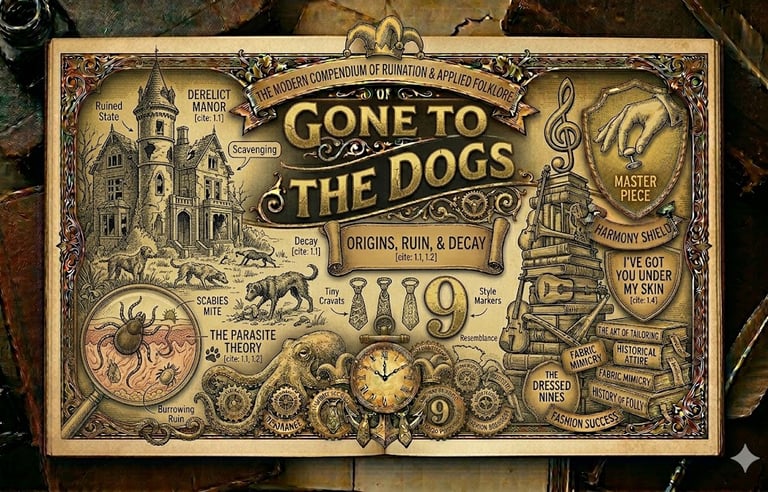
This idiom is used to describe a person, organization, or place that has significantly deteriorated in quality, morals, or prosperity. It suggests a state of ruin or shameful decline, where a previously respectable entity has "given the heave-ho" to its standards and collapsed into a pathetic condition.
The Deep Dive
The origins of this expression are rooted in ancient social hierarchies and the historical treatment of domestic animals as the final recipients of "junk" resources.
Ancient Scraps: In many early cultures, including those of Ancient Greece and China, dogs were not kept primarily as pampered pets but as utilitarian scavengers. Food that was considered unfit for human consumption—spoiled meat, bones, or kitchen refuse—was literally "gone to the dogs." Consequently, for a person’s fortunes or a city's standards to go to the dogs meant they had sunk to the level of common refuse.
Medieval Taboos: During the Middle Ages, being compared to a dog was a severe insult. To say a situation had gone to the dogs implied it had moved outside the lines of civilized society and into a realm of filth and lawlessness. This sentiment was reinforced by the biblical and historical view of dogs as symbols of those who lived on the fringes of human habitations.
Modern Social Critique: By the 19th century, the phrase became a favorite of social commentators and politicians to lament the perceived decline of the British Empire or the values of the past. It remains a popular way to express a cynical view of contemporary changes, suggesting that the current state of affairs is a shadow of its former glory.
Fast Facts
The "Dog’s Dinner" Contrast: While "gone to the dogs" refers to a general decline, a "dog's dinner" describes a specific event or object that has been made into a total mess or a chaotic failure.
Global Variations: In many languages, the "dog" remains the primary metaphor for low status. In Chinese, the phrase gǒu bù lǐ (even a dog wouldn't touch it) is used to describe something of exceptionally poor quality.
References
Ammer, C. (2013). The Dictionary of Clichés. Skyhorse Publishing.
Ayto, J. (1990). Dictionary of Word Origins. Arcade Publishing.
Oxford English Dictionary. (2026). The Zoomorphic Metaphors of Social Decline.