Good Egg
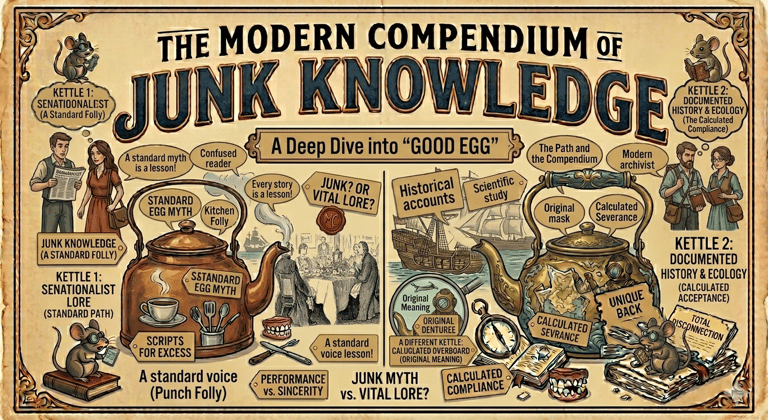
The Definition
A person who is fundamentally honest, reliable, and kind; a "thoroughly decent fellow." It describes someone whose character is sound all the way through, with no hidden "rottenness" or unpleasant surprises.
The Deep Dive
This is a "high-protein" piece of junk knowledge from the elite boarding schools of Late Victorian and Edwardian England (c. 1880–1910). While we now use it for anyone from a helpful neighbor to a loyal dog, the origin is a literal, sensory test of quality.
Before the era of refrigerated transport and "sell-by" dates, an egg was a bit of a gamble. From the outside, a fresh egg and a sulfurous, rotten one look identical.
The Shell Game: You couldn't know the truth until you "cracked the shell." In the pressurized social environment of a British public school (like Eton or Harrow), a new student or a potential friend was viewed with the same suspicion.
The "Bad Egg" Precursor: The phrase actually started in the negative. In the mid-1800's, a "Bad Egg" was a person who looked respectable on the surface but proved to be dishonest or "stinky" once you got to know them.
The Oxford Shift: Around 1900, students at Oxford and Cambridge inverted the insult. A "Good Egg" became a superlative for a friend who, when "cracked open" by a difficult situation, proved to be solid, fresh, and "good to the core."
The phrase was immortalized in the 1920's by the novelist P.G. Wodehouse, whose character Bertie Wooster frequently used it to describe his well-meaning but often dim-witted friends. By the time the Jazz Age was in full swing, "Good Egg" had become the ultimate compliment for anyone with a "sunny-side up" personality.
Fast Facts
The "Candling" Link: Before the idiom became popular, the only way to tell a "good egg" without breaking it was "candling"—holding the egg up to a candle flame to see the silhouette of the yolk inside.
The "Egg" as Person: "Egg" has been slang for a person since the 16th century (Shakespeare used it in Macbeth as an insult for a young boy: "What, you egg! Young fry of treachery!").
The "Hard-Boiled" Contrast: While a "Good Egg" is kind, a "Hard-Boiled" person (slang from the 1920's) is someone who has become tough, cynical, and emotionless—like an egg cooked for too long.
References
Wodehouse, P. G. (1923). The Inimitable Jeeves.
Ammer, C. (2013). The Dictionary of Clichés. Skyhorse Publishing.
Flexner, S. B. (1982). Listening to America. Simon & Schuster.
The Oxford English Dictionary. (2026). Egg (n.). Oxford University Press.