Good Riddance
The Definition
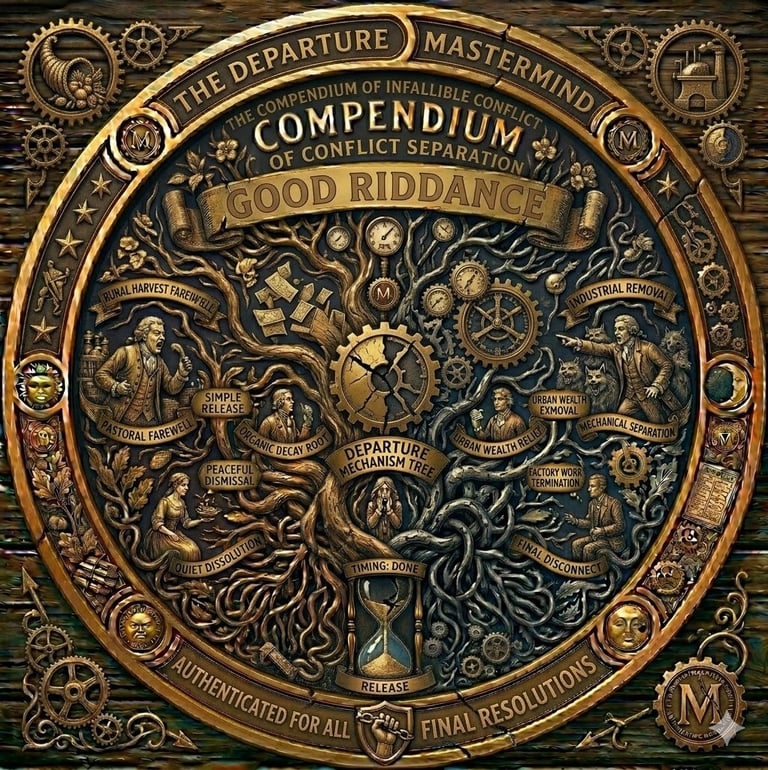
This idiom is an expression of relief or satisfaction that a bothersome person, a difficult situation, or an unwanted object is finally gone. It marks a decisive conclusion to a troublesome relationship or ordeal, emphasizing that the departure is a positive development for those remaining.
The Deep Dive
The history of this phrase reveals a linguistic evolution from a neutral description of clearing out "junk" to a sharp, emotionally charged dismissal.
Shakespearean Origins: While the word riddance (derived from the Middle English ridden, meaning to clear or deliver) existed earlier, William Shakespeare is credited with popularizing its use as a snub. In Troilus and Cressida (1602), the character Patroclus says to Thersites, "A good riddance," during a particularly tense exchange. This established the phrase as a standard way to celebrate the exit of an irritant.
The "Rubbish" Context: Historically, "riddance" was a technical term used in household and farm management. It referred to the act of "ridding" a space of pests, debris, or waste. To have a "good riddance" was to successfully purge a physical area of a hindrance. When applied to people, it implies that the individual’s presence was as burdensome as literal refuse.
Modern Resilience: Unlike many idioms that have softened over time, "good riddance" remains a blunt instrument of social finality. It represents a moment where the "flock" is finally free of a disruptive element. The phrase gained significant 20th-century cultural traction through music and literature, often paired with "to bad rubbish" to further emphasize the low regard for the departing party.
Fast Facts
The "Bad Rubbish" Appendage: The full expression "Good riddance to bad rubbish" became common in the early 19th century, reinforcing the idea that the person leaving was not only unwanted but fundamentally lacking in value.
Grammatical Shift: In its earliest forms, "riddance" was often used with the verb to make (e.g., "to make a good riddance of it"), whereas modern usage has turned the phrase into a standalone exclamation.
References
Shakespeare, W. (1602). Troilus and Cressida.
Ammer, C. (2013). The Dictionary of Clichés. Skyhorse Publishing.
Oxford English Dictionary. (2026). The Etymology of Clearance and Dismissal.