Grain of Salt
The Definition
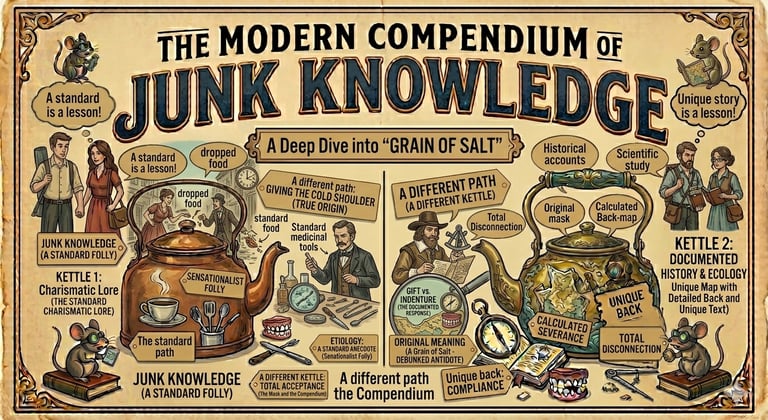
To view a statement, claim, or piece of information with a healthy dose of skepticism. It suggests that the "truth" being presented might be exaggerated, biased, or flavored with a bit of "junk" that needs to be neutralized before it can be swallowed.
The Deep Dive
This is a literal piece of "junk knowledge" from the high-stakes world of Roman pharmacology. The phrase is attributed to Pliny the Elder, who in his Naturalis Historia (77 AD) claimed to have discovered the secret recipe for a universal antivenom used by King Mithridates VI of Pontus.
Mithridates was famously terrified of being poisoned by his rivals. To protect himself, he spent years ingesting tiny, non-lethal doses of various toxins to build up an immunity—a process now known as mithridatism.
The Secret Recipe: Pliny recorded the King's daily preventative: two dried walnuts, two figs, and twenty leaves of rue, all pounded together.
The "Grain": Crucially, the final instruction was to take this bitter, potentially toxic concoction "addito salis grano" (with a grain of salt added).
The Function: In the Roman mind, salt was a powerful purifier. Adding a single grain wasn't just for flavor; it was believed to be the essential "buffer" that made the medicine—and the potential poison within it—safe to ingest.
The phrase moved from the pharmacy to the library in the 17th century. Scholars began using it as a metaphor for "digesting" a difficult or unlikely story. To take a claim "with a grain of salt" meant you were adding your own intellectual "purifier" to help swallow a story that might otherwise be "hard to stomach."
Fast Facts
The "Pinch" Variation: In Modern English, we often say a "pinch of salt," which is a larger, more culinary measurement than the Roman "grain" (grano), reflecting our modern move from medicine to the kitchen.
The Salt of the Earth: This is a linguistic cousin to being "the salt of the earth" (meaning a person of great value), referencing the historical reality that salt was once so valuable it was used as currency.
The First Print: While Pliny wrote it in 77 AD, the figurative English use ("take it with a grain of salt") didn't become common in literature until the 1640's.
References
Pliny the Elder. (77 AD). Naturalis Historia. (Book XXIII, Section 149).
Mayor, A. (2010). The Poison King: The Life and Legend of Mithradates, Rome's Deadliest Enemy. Princeton University Press.
Ammer, C. (2013). The Dictionary of Clichés. Skyhorse Publishing.
The Oxford English Dictionary. (2026). Salt (n.1). Oxford University Press.