Great Emu War
The Definition
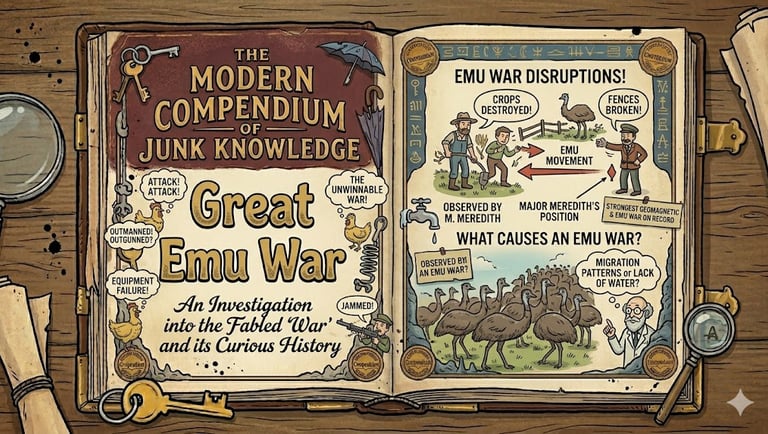
A bizarre nuisance-management military operation undertaken in Australia in late 1932 to address public concern over the number of emus "ravaging" crops in the Campion district of Western Australia. It is the only recorded conflict where a modern military—armed with Lewis machine guns—was deployed against a flightless bird population, and, by most historical accounts, lost.
The Deep Dive
The "junk knowledge" behind the Emu War is that it wasn't a "war" in the traditional sense, but a botched public relations stunt. Following WWI, the Australian government settled veterans on marginal lands to farm wheat. When the Great Depression hit and emus migrated inland for water, the "soldier-settlers" found their fences destroyed and their crops eaten by 20,000 birds.
The Military Deployment: Major G.P.W. Meredith of the Seventh Heavy Battery of the Royal Australian Artillery led the "offensive" with two soldiers, two Lewis guns, and 10,000 rounds of ammunition. The military assumed the birds would be easy targets for machine-gun fire.
Guerrilla Tactics: The emus proved to be surprisingly resilient and tactically brilliant. They traveled in small groups rather than large mobs, making them difficult to target. Observers noted that each group seemed to have a "sentinel"—a large male that would stand guard and warn the others to scatter the moment the soldiers approached.
The "Tank" Bird: The Lewis guns were ineffective at long range, and the emus could run at speeds up to 30 mph. Even when hit, the birds' thick feathers and tough hides acted like natural armor. Major Meredith famously remarked, "If we had a military division with the bullet-carrying capacity of these birds, it would face any army in the world."
The Emu War reached peak "junk" status in the internet era as a favorite "weird history" meme. It represents the "junk" of human arrogance: the belief that superior technology and firepower can easily overcome the raw, chaotic persistence of nature. After two weeks and thousands of rounds fired, only a few hundred emus had been killed, and the military withdrew in defeat.
Fast Facts
The "Ambush" Fail: During one attempt, the soldiers set up an ambush near a local dam where 1,000 emus were gathered. The gun jammed after only 12 rounds were fired, allowing the entire flock to escape unscathed.
The Truck Tactic: In a desperate move, the soldiers mounted a machine gun on the back of a truck to chase the birds. However, the terrain was so bumpy that the gunner couldn't aim, and the driver was too busy trying to keep up with the birds to steer effectively.
Nature Wins: Eventually, the government realized that bounties were more effective than bullets. Between 1945 and 1960, over 280,000 emus were culled by local farmers using traditional hunting methods, finally bringing the "insurgency" under control.
References
The Argus. (1932). The Emu War: Artillery to be Used. Melbourne.
Johnson, M. (2006). The Great Emu War: A Military History of the Flightless Insurgency.
Western Australian Department of Agriculture. (2026). Historical Pests: The 1932 Emu Campaign.