Great Stork Derby
The Definition
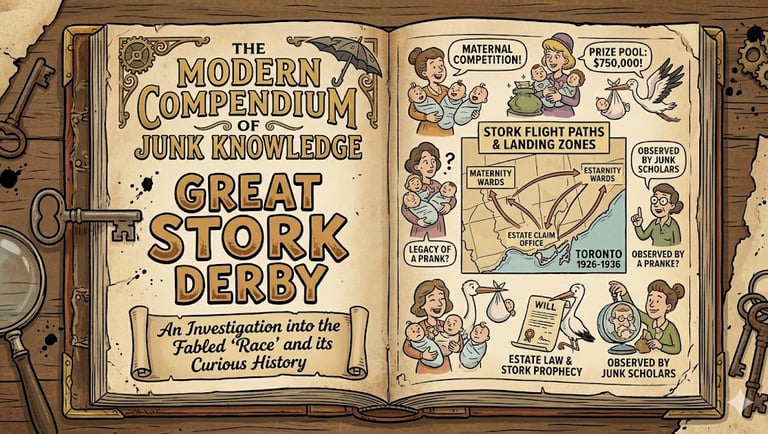
An extraordinary legal and social phenomenon that occurred in Toronto, Canada, between 1926 and 1936. Triggered by a bizarre clause in the will of a wealthy, eccentric lawyer, it became a decade-long high-stakes "procreation race" where local women competed to have the most children in order to inherit a massive fortune.
The Deep Dive
The "junk knowledge" behind the Great Stork Derby is that it was essentially a posthumous practical joke on the legal system. Charles Vance Millar, a successful lawyer and investor, was known for his "mischievous" sense of humor. He died in 1926 with no heirs and a will designed to poke fun at human greed and social conventions.
The Clause: The tenth clause of Millar’s will stated that the "residue" of his estate (which turned out to be worth about $750,000—a fortune during the Depression) should be liquidated ten years after his death and given to the Toronto woman who had given birth to the most children in that decade.
The Depression Context: The race took place during the height of the Great Depression. For the competing families, many of whom were living in extreme poverty, the "Derby" wasn't a game; it was a desperate hope for survival. The media turned it into a circus, tracking the "standings" of various mothers like sports scores.
The Legal Battle: As the ten-year mark approached, the Ontario government tried to invalidate the will and seize the money for the province. However, the Supreme Court of Canada upheld the will, famously stating that while the clause might be "distasteful," it did not violate public policy.
The Derby reached peak "junk" status in 1936, when the contest finally ended. It represents the "junk" of human nature: the way a single man’s eccentric whim could manipulate the biological lives of dozens of families and captivate an entire nation for ten years.
Fast Facts
The Winners: Four women (Annie Smith, Kathleen Nagle, Lucy Timleck, and Isabel Maclean) tied for first place. Each had nine children in the ten-year span. They each received roughly $125,000—enough to buy homes and secure their families' futures during the hardest economic time in history.
The "Illegitimate" Disqualification: Two women were disqualified from the tie-break because some of their children were born out of wedlock. This sparked a massive ethical debate about the definition of "child" in the 1930's.
Millar’s Other Pranks: The Stork Derby wasn't his only trick. He also left shares of a racetrack to anti-gambling activists and a villa in Jamaica to three lawyers who famously detested each other, on the condition they all lived in it together.
References
Marchildon, G. P. (1997). The Great Stork Derby. University of Toronto Press.
The Toronto Star Archives. (2026). The Race for the Millar Fortune: 1926-1936.
Supreme Court of Canada. (1934). In re Millar Estate.