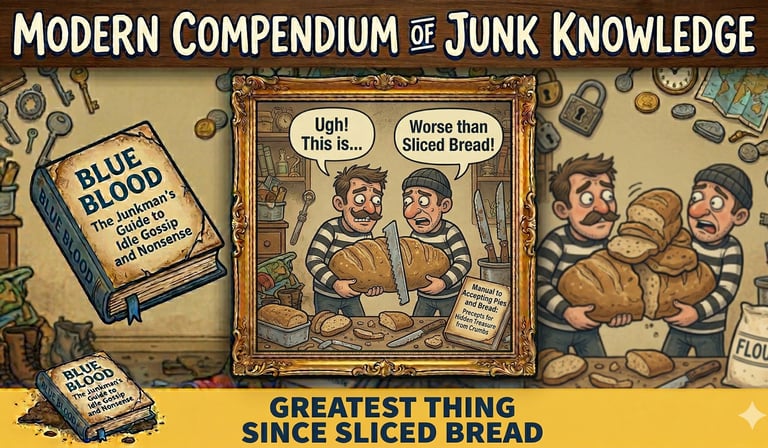
Greatest Thing Since Sliced Bread
The Definition
A hyperbolic expression used to describe a new invention, idea, or person that is perceived as being exceptionally good, innovative, or life-changing. It sets "sliced bread" as the ultimate benchmark for human progress.
The Deep Dive
This is a "high-gluten" piece of junk knowledge that traces back to a very specific date: July 7, 1928. Before this, if you wanted bread, you bought a whole loaf and hacked at it with a serrated knife at the kitchen table, resulting in uneven, jagged doorstops of varying thickness.
The Inventor (Otto Frederick Rohwedder): A jeweler from Iowa spent years and his entire life savings developing a machine that could both slice and wrap a loaf of bread. His first prototype was destroyed in a fire in 1917, and he had to start over from scratch.
The Debut: The first commercial use of the machine was at the Chillicothe Baking Company in Missouri. They marketed their product as "Kleen Maid Sliced Bread."
The Marketing Hype: The advertising campaign didn't hold back. A full-page ad in the Chillicothe Constitution-Tribune described it as "the greatest forward step in the baking industry since bread was wrapped."
The "Junk" Ban: During World War II (1943), the US government actually banned sliced bread to conserve wax paper and the high-grade steel used in the slicing machines. The public outcry was so intense—with one woman writing to the New York Times claiming that sliced bread was vital to "the morale of the household"—that the ban was lifted after only two months.
The phrase "the greatest thing since sliced bread" didn't actually become a popular idiom until the 1950's. It was popularized by American soldiers returning from the war and by comedians like Red Skelton, who used it to mock the relentless "new and improved" marketing of the post-war era. It transformed a genuine industrial breakthrough into a permanent piece of linguistic sarcasm.
Fast Facts
The "Wrapped Bread" Ancestor: Before sliced bread, the "greatest thing" was wrapped bread (introduced around 1910), which kept the loaf fresh and sanitary.
The "Sandwich" Connection: Sliced bread is credited with the explosion of the American sandwich culture. Without uniform slices, the "PB&J" or the "Club Sandwich" was a structural nightmare.
The First Print: The Chillicothe Constitution-Tribune (1928) is the holy grail of this entry, featuring the headline: "Sliced Bread is Made Here!"
References
Rohwedder, O. F. (1928). U.S. Patent No. 1,867,377: Bread Slicing Machine.
The New York Times. (1943, January). The Sliced Bread Ban.
Ammer, C. (2013). The Dictionary of Clichés. Skyhorse Publishing.
The Oxford English Dictionary. (2026). Bread (n.1). Oxford University Press.