Green Around Gills
The Definition
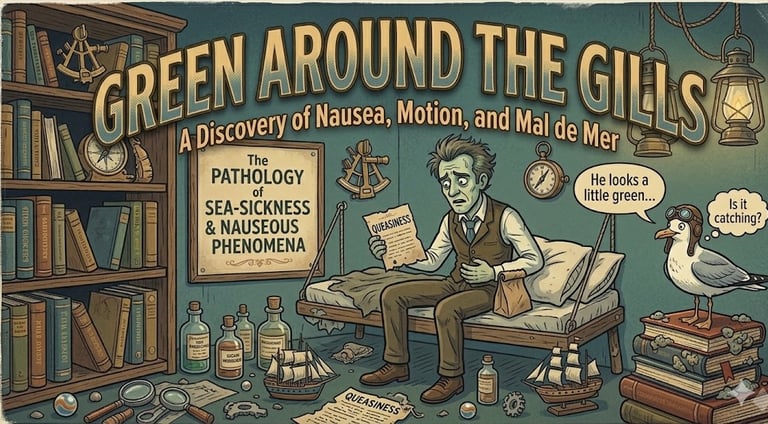
This idiom is used to describe a person who looks physically ill, particularly someone experiencing nausea, motion sickness, or extreme faintness. It refers to a sickly, pale, or yellowish-green complexion that often precedes vomiting or a loss of consciousness.
The Deep Dive
The expression is a "junk knowledge" hybrid that combines human physiology with a metaphorical reference to fish, emerging in the mid-19th century.
Nautical Connections: The "gills" in the phrase refer to the area around a person's jaw and neck, likening human anatomy to the respiratory organs of a fish. Historically, the idiom began as "white around the gills" or "rosy around the gills" in the 1600's to describe various states of health. By the 1800's, "green" became the standard color associated with the phrase, specifically linked to the sea-sickness experienced by sailors and passengers on turbulent waters.
Physiological Reality: When a person becomes nauseated, the body’s blood vessels constrict near the surface of the skin as part of a stress response. This diversion of blood to the core organs leaves the face looking pale or ashen. In certain lighting, or when combined with the natural yellow undertones of the skin, this pallor can take on a distinctive greenish hue.
Linguistic Adoption: The phrase became a staple of American and British English as a polite way to describe someone on the verge of being sick without being overly graphic. It suggests a state of vulnerability where an individual is struggling to maintain their composure in the face of physical distress.
Fast Facts
The "Green with Envy" Contrast: While both idioms use the color green, "green around the gills" refers strictly to physical illness, whereas "green with envy" refers to a psychological state of jealousy, likely originating from the idea of "bile" affecting one's temperament.
The "Blue" Variation: In some older regional dialects, one might be described as "blue around the gills" if they were suffering from extreme cold or respiratory distress, though the "green" version remains the dominant form for nausea.
References
Ammer, C. (2013). The Dictionary of Clichés. Skyhorse Publishing.
Ayto, J. (1990). Dictionary of Word Origins. Arcade Publishing.
Oxford English Dictionary. (2026). The Ichthyological Metaphors of Human Health.