Green with Envy
The Definition
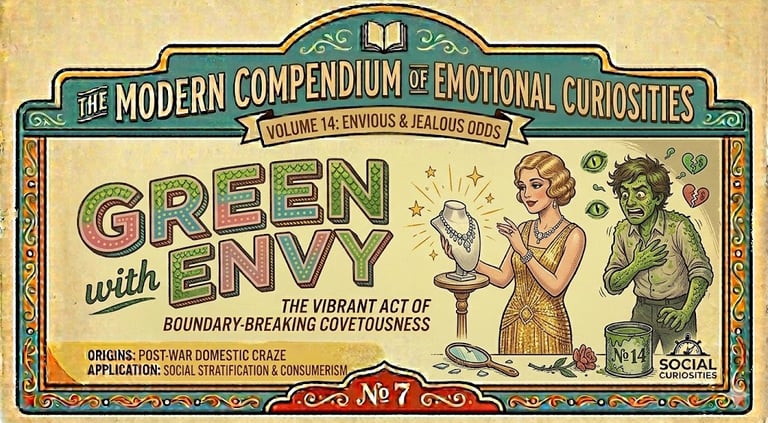
This idiom describes a state of intense jealousy or resentment toward another person's advantages, possessions, or luck. It suggests that the emotion is so powerful it physically transforms the sufferer, marking them with a hue traditionally associated with imbalance and ill-will.
The Deep Dive
The association between the color green and envy is an ancient concept rooted in early medical theories regarding the fluids, or humors, within the human body.
The Bilious Theory: In Ancient Greece, physicians believed that emotions were tied to the balance of four bodily humors. An excess of "yellow bile" or "black bile" was thought to cause a pale or greenish complexion. Since a person consumed by jealousy often appeared physically ill or "nauseated" by another's success, the color green became the visual shorthand for an agitated, envious spirit.
Literary Standardization: William Shakespeare played a significant role in cementing this connection in the English language. In Othello, he famously refers to jealousy as the "green-eyed monster which doth mock the meat it feeds on." Later, in The Merchant of Venice, he mentions "green-eyed jealousy." These vivid descriptions transformed a vague medical theory into a permanent cultural metaphor.
Modern Perception: Unlike "green around the gills," which indicates a temporary physical ailment, being "green with envy" implies a deeper psychological state. It represents a moment where an individual’s internal contentment is poisoned by comparison, leading to a visible—if metaphorical—change in their demeanor.
Fast Facts
The "Green-Eyed Monster": This specific variation of the idiom emphasizes the consuming nature of jealousy, portraying it as a creature that lives within the envious person and eventually destroys them.
Color Psychology: In modern color theory, green can represent growth and nature, but when applied to human emotion, it remains tethered to these ancient warnings about the corrosive power of envy.
References
Shakespeare, W. (1604). Othello.
Ammer, C. (2013). The Dictionary of Clichés. Skyhorse Publishing.
Oxford English Dictionary. (2026). The Humoral Origins of Color-Based Idioms.