Greenhorn
The Definition
"Greenhorn" is used to describe an individual who is completely inexperienced, naive, gullible, or new to a specific trade, subculture, or environment. It signifies a raw novice who stands out instantly because they lack the unvarnished, street-smart instincts and practical skills that can only be acquired through long-term exposure and trial-by-fire experience.
The Deep Dive
It was a direct, literal carryover from the world of traditional animal husbandry and livestock trading, long before it became a standard piece of frontier and industrial workplace slang.
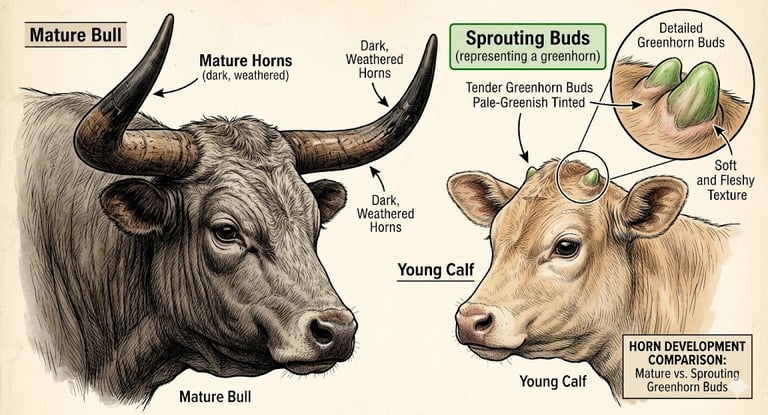
The Biology of the Horn: The origin of the phrase belongs to the pasture. When a young bull, ox, or calf first begins to sprout its horns, the new bony growths are not yet hardened into the dense, dark, polished weapons seen on mature animals. Instead, a young animal's developing horns are soft, tender, and covered in a fresh, sensitive layer of skin and blood vessels that often carries a distinct, pale, greenish-translucent tint. In the livestock markets of the 15th and 16th centuries, these young, unformed cattle were referred to literally by drovers and butchers as "green-horns."
The Marketplace Squeeze: Because a greenhorn animal was young, it was structurally unproven. It lacked the muscle mass for heavy plowing and the thick hide required for premium leather production. If a naive buyer went to a livestock auction and was swindled into buying an immature animal at a mature price, the veteran traders would mock the buyer's utter lack of market savvy.
The Military and Frontier Shift: By the 1600’s, the phrase broke out of the cattle pens and marched onto the battlefields of Europe. Veterans of the English army began using "greenhorn" as a derogatory term for raw, unvarnished military recruits who had just arrived at camp.
The American Immigrant Experience: During the 19th-century expansion of the United States, the idiom underwent its final major cultural evolution. It became the definitive slang term for newly arrived European immigrants who landed at ports like Ellis Island before heading west. These individuals were completely unfamiliar with American customs, currencies, and languages, making them prime targets for local city grifters, high-interest rail ticket swindlers, and predatory independent contractors.
Fast Facts
The "Left-Handed Monkey Wrench" Test: A universal tradition across machine shops, construction sites, and maritime crews involves hazing the resident greenhorn by sending them on a wild-goose chase to locate a non-existent item, such as a left-handed monkey wrench.
The Deadliest Catch Legacy: The phrase was deeply popularized in 21st-century reality television by the hit series Deadliest Catch, where the veteran captains and crew members of Alaskan crab fishing boats universally refer to first-year deckhands as "greenhorns," highlighting the extreme, life-threatening stakes of being an unproven novice on a hazardous sea.
References
Smyth, W. H. (1867). The Sailor's Word-Book: An Alphabetical Digest of Nautical Terms. Blackie and Son. (Tracking the crossover of livestock and military novice jargon into shipboard hierarchies).
Ammer, C. (2013). The Dictionary of Clichés. Skyhorse Publishing.
Oxford English Dictionary. (2026). The Biological Origins of Bovine Metallurgy and the Proliferation of Industrial Apprentice Pejoratives.