Happy as a Clam
The Definition
To be extremely content, satisfied, or peaceful. It describes a state of carefree happiness, often implying that the person is currently safe from any external threats or stresses.
The Deep Dive
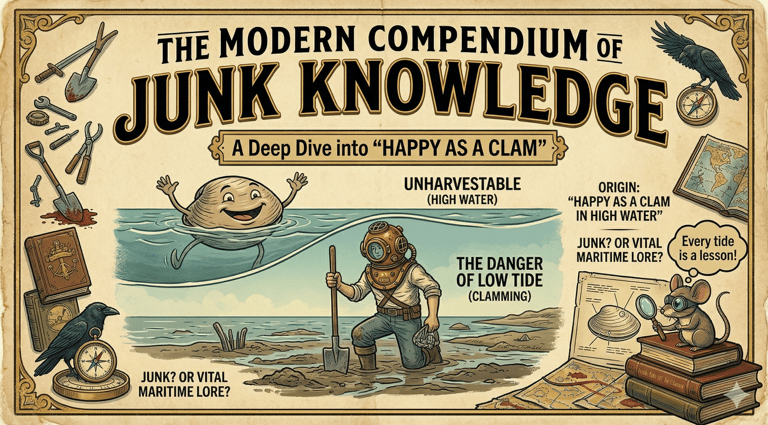
This is one of the most frequently truncated idioms in the English language. When we say someone is "happy as a clam," we are actually only quoting the first half of a 19th-century American proverb. The full phrase is: "Happy as a clam at high water."
To understand why a clam would be happy, you have to look at the "commute" of a clambake enthusiast. Clams live in the intertidal zone—the area of the shore exposed during low tide and covered during high tide.
The Low Tide Danger: When the tide goes out, the mud flats are exposed. This is when humans (with shovels) and shorebirds (with sharp beaks) go "clamming." For a clam, low tide is a period of mortal peril.
The High Tide Safety: When the tide comes in ("high water"), the clams are covered by several feet of ocean. They are invisible to land predators, and the water brings in a fresh supply of plankton for them to eat. At high water, a clam is fed, hydrated, and—most importantly—utterly untouchable.
The phrase originated in the coastal regions of New England and the Mid-Atlantic in the early 1800's. It was popularized by frontier writers and humorists like Thomas C. Haliburton, who used the "high water" suffix to emphasize a state of perfect, unassailable security.
Fast Facts
The "Smile": Some junk knowledge suggests the phrase refers to the way a clam shell looks like a "smile" when slightly open. While poetic, clams "gape" when they are dying or stressed, so a "smiling" clam is actually a very unhappy one.
Literary Debut: The phrase first appeared in print in the Salmagundi papers (1807) and was later used by legendary poet John G. Saxe in the 1840's.
The Survival Instinct: Clams can live for decades (and some species for centuries), but only if they stay "happy" (covered) during those dangerous low tides.
References
Haliburton, T. C. (1836). The Clockmaker. Joseph Howe.
Irving, W., Irving, E., & Paulding, J. K. (1807). Salmagundi; or, The Whim-whams and Opinions of Launcelot Langstaff, Esq. & Others.
Saxe, J. G. (1840). The Proud Miss MacBride. (Poem referencing "Happy as a clam at high tide").
Ammer, C. (2013). The Dictionary of Clichés. Skyhorse Publishing.