Hard Act to Follow
The Definition
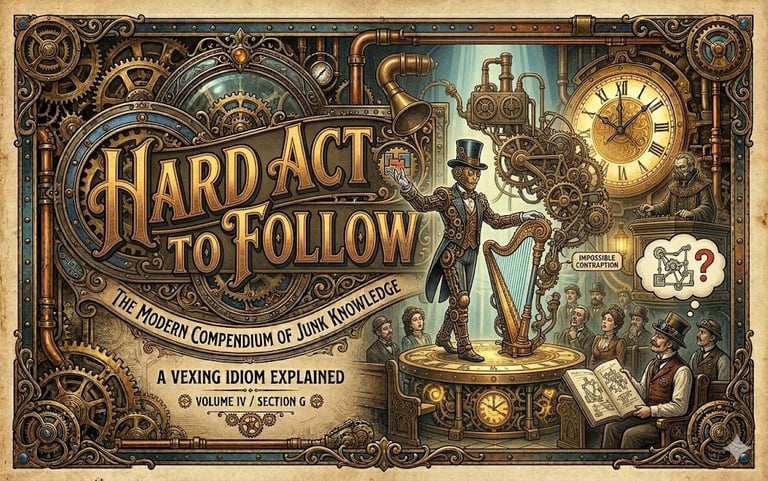
A "hard act to follow" refers to a person or performance so exceptional that whoever comes next is almost certain to look inferior by comparison. It describes the daunting challenge of succeeding someone who has set an impossibly high standard, leaving their successor in a position where even the greatest effort might feel like a disappointment.
The Deep Dive
This idiom is a direct legacy of the grueling and highly competitive world of American Vaudeville in the late 19th and early 20th centuries.
The Bill Order: In a Vaudeville show, the "bill" was the lineup of diverse acts—singers, comedians, acrobats, and animal trainers. The order was meticulously planned by the theater manager. The "star" or the most explosive act was often placed just before the finale. If that performer "knocked 'em dead," the energy in the room peaked.
The "Death" Slot: The performer who had to go on immediately after a show-stopper was in a "hot mess" of a situation. The audience was often emotionally exhausted or still buzzing from the previous act, making them less receptive to the next person. In the industry, being the act that followed a legend was considered a professional curse.
Corporate and Creative Succession: By the mid-20th century, the phrase migrated out of the theater. It is now commonly used to describe leadership transitions. When a visionary CEO or a beloved local figure retires, the person taking over faces the "junk" of high expectations. They aren't just doing the job; they are competing with the ghost of a perfect performance.
Fast Facts
The "Tough Act" Variation: Occasionally shortened to "a tough act to follow," the meaning remains identical, though "hard" was the more common descriptor in early theatrical journals.
Psychological Impact: In social psychology, this is related to the "contrast effect," where our perception of something is significantly altered by the thing that immediately preceded it.
References
Ammer, C. (2013). The Dictionary of Clichés. Skyhorse Publishing.
Lighter, J. E. (1994). Historical Dictionary of American Slang.
Oxford English Dictionary. (2026). The Vaudeville Origins of Professional Succession Metaphors.