Hard Boiled
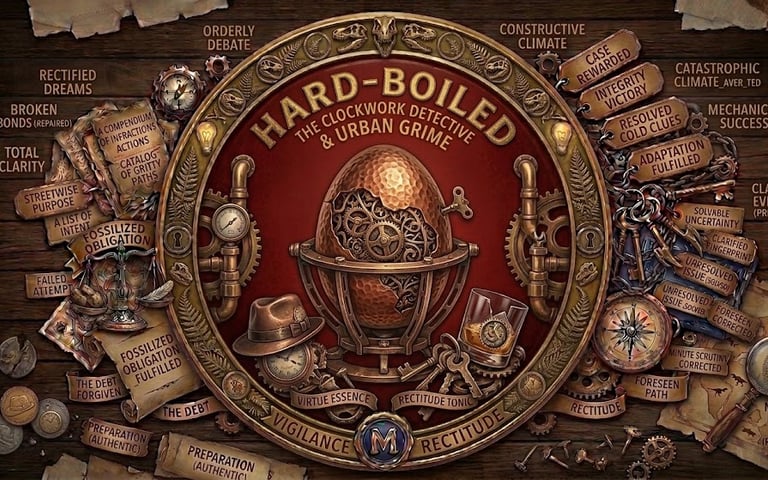
The Definition
This idiom describes an individual who is tough, cynical, and unsentimental. It suggests a person who has become hardened by experience, lacking emotional sensitivity or "junk" sentimentality in their dealings with others. It is the hallmark of a personality that remains unyielding under pressure.
The Deep Dive
The term originated in the late 19th century as a culinary metaphor, drawing a direct parallel between the physical transformation of an egg and the psychological hardening of a human being.
Culinary Metaphor: Just as an egg starts as a fragile, liquid substance and becomes firm and "tough" through the application of heat, a person was said to become "hard-boiled" through the friction and heat of difficult life experiences. By the 1880's, American slang used the term to describe people who were no longer easily manipulated or moved to tears.
The "Hard-Boiled" Detective: The phrase reached its cultural peak in the 1920's and 30's with the rise of "hard-boiled" detective fiction. Writers like Dashiell Hammett and Raymond Chandler created protagonists who were the antithesis of the "straight arrow" Victorian gentleman. These detectives were gritty, pragmatic, and often moved "outside the lines" of traditional morality to get results, reflecting the disillusionment of the post-WWI era.
Military and Labor Roots: During World War I, the term was frequently used to describe strict, unforgiving drill sergeants. A "hard-boiled" officer was one who demanded absolute discipline and showed no mercy for weakness. This reinforced the idea that being hard-boiled was a necessary adaptation for survival in a world that offered no safety nets.
Fast Facts
The "Soft-Boiled" Contrast: While rarely used today, "soft-boiled" was once the contemporary antonym, describing a person who was overly sentimental, naive, or easily influenced by their emotions.
The "Tough Egg" Connection: In the early 20th century, a person might also be called a "tough egg" or a "bad egg," linking the culinary metaphor of the egg to an individual's fundamental character and reliability.
References
Chandler, R. (1950). The Simple Art of Murder.
Ammer, C. (2013). The Dictionary of Clichés. Skyhorse Publishing.
Oxford English Dictionary. (2026). The Culinary Roots of American Noir Vernacular.