Hat in Hand
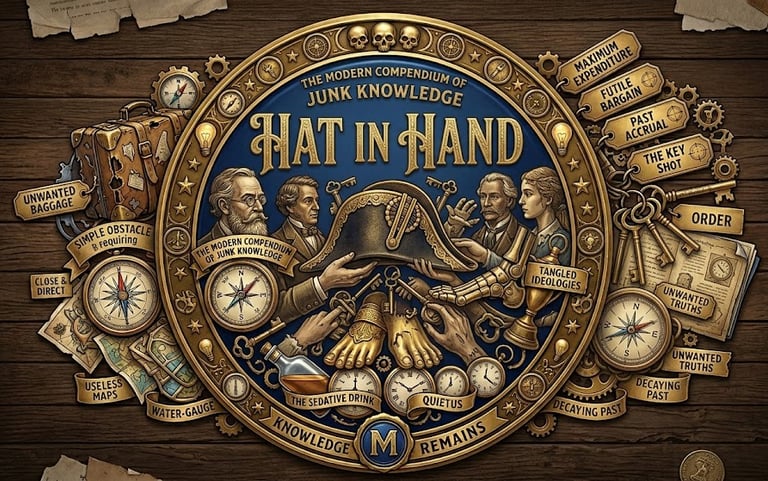

The Definition
To approach someone in a humble, apologetic, or entreating manner. It describes the act of asking for a favor, a job, or forgiveness from a position of weakness or lower social standing.
The Deep Dive
The "junk knowledge" behind this phrase is the rigid social hierarchy of headwear that dominated Western culture for centuries. Before the mid-20th century, a hat was not just an accessory; it was a physical manifestation of one's rank. To keep it on was to assert your status; to take it off was to surrender it.
In the 18th and 19th centuries, the rules of "uncovering" (removing one's hat) were as complex as modern tax codes.
The Power of the Uncovered Head: When a tenant approached a landlord, or a clerk entered the office of a high-ranking executive, the first move was to remove the hat. By holding the hat in one's hand—rather than placing it on a peg or keeping it on the head—the person was signaling that they were "in transit" or a temporary petitioner who did not yet have the right to "hang their hat".
The Vulnerability of the Grip: Holding a hat in both hands in front of the body is a physically defensive and humble posture. It occupies the hands, preventing them from being used for aggression, and lowers the shoulders. This "hat in hand" stance was the universal body language of the man who needed something he could not demand.
The phrase reached its "junk" peak during the Great Depression, appearing in countless stories of men seeking work. It moved from a literal requirement of etiquette to a metaphor for any situation where one must "swallow their pride." It represents the "junk" of human ego: the realization that sometimes, to move forward, you have to stand before someone else and admit you are smaller than they are.
Fast Facts
The "Cap in Hand" Cousin: In British English, the phrase is often "Cap in Hand," reflecting the working-class flat cap rather than the American middle-class fedora or Stetson.
The Hat-Tip Evolution: The modern "tip of the hat" is the vestigial remains of the "hat in hand" gesture—a shorthand way of showing respect without having to fully disrobe your head.
The Quaker Rebellion: In the 1600's, Quakers famously refused to go "hat in hand" even to the King, believing that all men were equal under God. This "Hat Honor" controversy led to many being imprisoned for what was seen as a radical act of disrespect.
References
Grose, F. (1785). A Classical Dictionary of the Vulgar Tongue.
Ammer, C. (2013). The Dictionary of Clichés. Skyhorse Publishing.
Taggart, C. (2010). Her Who Must Be Obeyed: The Phrases and Sayings That Make Us Who We Are. Michael O'Mara Books.
The Oxford English Dictionary. (2026). Hat (n.). Oxford University Press.