Have Your Cake and Eat It Too
The Definition
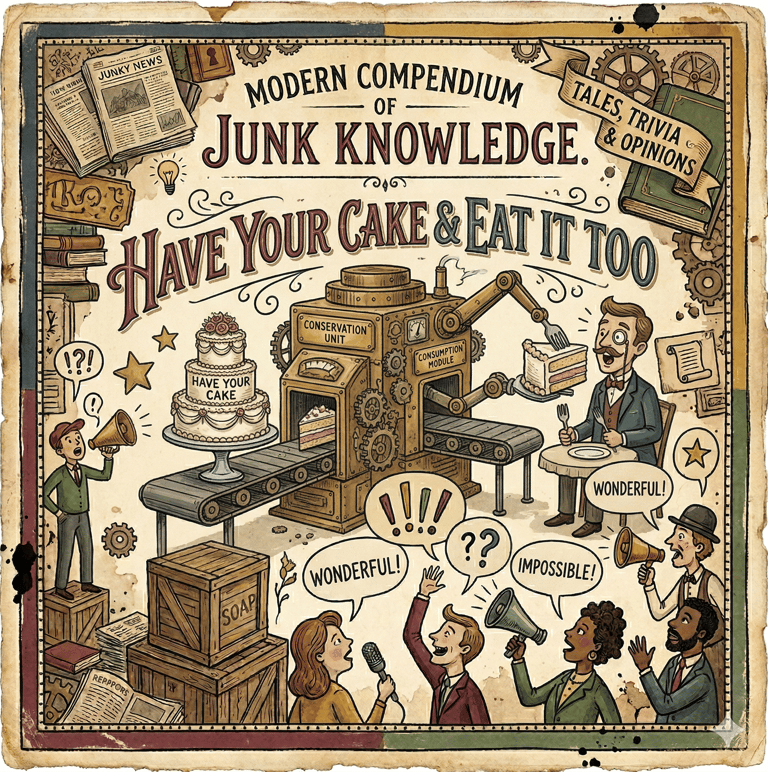
To want more than one can have or deserve; to attempt to enjoy two desirable but mutually exclusive alternatives. It describes a situation where a person wants to benefit from a resource while also keeping that resource entirely intact.
The Deep Dive
This is a classic "junk knowledge" phrase that often feels grammatically backwards to the modern ear. Most people argue that it should be "Eat your cake and have it too," because you obviously have to have the cake before you can eat it.
In reality, the "junk" lies in our modern interpretation of the word "have." In the 16th century, to "have" your cake meant to keep it or possess it in its original, beautiful form.
The Paradox of Consumption: If you eat the cake, it is gone; you no longer "have" it in your pantry or on your display stand. If you "have" (keep) the cake to look at or save for later, you cannot enjoy the taste of it now.
The Original Syntax: The phrase actually started in the "logical" order. The earliest recorded version, found in a 1546 collection by John Heywood, was: "Wolde ye bothe eate your cake, and haue your cake?"
Over the centuries, the words drifted into the modern "Have... and Eat..." sequence. This shift caused decades of linguistic confusion, leading many to believe the idiom was a nonsensical "British-ism." However, the core message remains a fundamental lesson in trade-offs: you cannot consume your assets and still expect to see them sitting on the shelf.
Fast Facts
The Unabomber Connection: The "backwards" nature of the phrase famously helped the FBI identify Ted Kaczynski. In his manifesto, he used the older, more linguistically accurate version: "eat their cake and have it too." His family recognized the specific phrasing as a quirk he shared with his brother.
Global Variations: The French say, "You can't have the butter and the money from the butter," while Italians remark, "You can't have a full wine barrel and a drunk wife."
The "Cake" Choice: In the 1500's, "cake" referred to a smaller, flatter, and often harder bread-like confection, making the idea of "keeping" it as a staple food item even more practical.
References
Heywood, J. (1546). A Dialogue Conteinyng the Nomber in Effect of All the Prouerbes in the Englishe Tongue.
Ammer, C. (2013). The Dictionary of Clichés. Skyhorse Publishing.
Taggart, C. (2010). Her Who Must Be Obeyed: The Phrases and Sayings That Make Us Who We Are. Michael O'Mara Books.
The Oxford English Dictionary. (2026). Cake (n.). Oxford University Press.