Have Your Work Cut Out For You
The Definition
To face a difficult or demanding task that will require significant time and effort. It implies that the scope of the job is already defined and dauntingly large.
The Deep Dive
The "junk knowledge" interpretation of this phrase often suggests it means the work has been shortened or made easier (as if the "cutting" has already been done for you). In reality, the origin is rooted in the 16th-century tailoring trade, and it actually implies the exact opposite of an easy day.
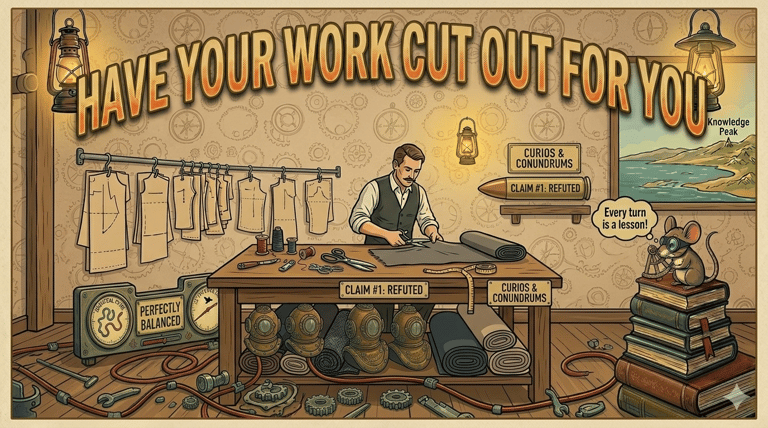
Before a tailor could begin the skilled work of sewing a garment, the fabric had to be "cut out" according to a pattern. Once the pieces were cut, the real labor began.
The Pile of Pieces: To have your "work cut out for you" meant that a master tailor or an assistant had already laid out and cut all the individual pieces of a suit or dress. You were now staring at a massive, pre-measured pile of fabric that had to be assembled.
No Escape: Unlike a creative project where you might adjust the scope as you go, "cut out" work was fixed. The pieces were there; the pattern was set. You couldn't make the sleeves shorter or the jacket smaller to save time. You were committed to the full labor of the original design.
The phrase transitioned from the tailor’s bench to general English by the early 1600's. It was famously used by writers like Anthony Trollope to describe someone facing a formidable challenge that they simply had to roll up their sleeves and finish.
Fast Facts
The "Cut" vs. "Sew": In historical garment guilds, the "Cutter" was often the most senior and highest-paid position, while the "Sewers" (who had the work "cut out" for them) performed the grueling, repetitive assembly.
The Pattern: The "cut out" pieces were often based on a "sloper" or "block"—a basic cardboard or paper template used to ensure consistency.
Evolution of Meaning: In its earliest usage (c. 1600), it sometimes meant to be "prepared" or "suited" for a task, but by the 1800's, it shifted exclusively to its modern meaning of facing a heavy workload.
References
Ammer, C. (2013). The Dictionary of Clichés. Skyhorse Publishing.
Trollope, A. (1864). Can You Forgive Her?. Chapman & Hall.
Cunnington, C. W. (1954). Handbook of English Costume in the Nineteenth Century. Faber and Faber.
The Oxford English Dictionary. (2026). Cut (v. and n.). Oxford University Press.