History of Pencil Erasers
The Definition
A pencil eraser (or "rubber") is an instrument used to remove markings from paper, typically those made by graphite pencils. It works through the principle of abrasion and adhesion: as the eraser is rubbed against the paper, it generates heat and friction that lifts the graphite particles off the fibers and traps them in the eraser's own debris.
The Deep Dive
The "junk knowledge" behind the eraser is that for over two centuries, humans used moist bread to fix their mistakes. Before the 1770's, if you were a writer or an architect who made a "stray mark," you would take a piece of bread, remove the crust, roll the dough into a ball, and rub it on the page.
The "Rubber" Discovery (1770): On April 15, 1770, the English chemist Joseph Priestley (the same man who discovered oxygen) noticed that a piece of natural caoutchouc (latex from a rubber tree) was much better at "rubbing out" lead pencil marks than bread was. He coined the name "rubber"—a bit of "junk" linguistic branding that stuck so well that the material is still called that in the UK today.
The "Edward Nairne" Accident: Legend says the commercial eraser was born from a mistake. In 1770, an English engineer named Edward Nairne meant to grab a piece of bread to fix a drawing but accidentally picked up a chunk of raw rubber instead. He was so impressed by its performance that he began selling "India Rubber" cubes for the staggering price of three shillings each.
The Perishability Problem: These early erasers were "junk" in a literal sense—they were organic, they smelled terrible, and they would eventually rot or turn into a sticky mess in the summer heat. It wasn’t until Charles Goodyear invented vulcanization in 1839 (the same process used for tires and boots) that rubber became stable, durable, and commercially viable for the long term.
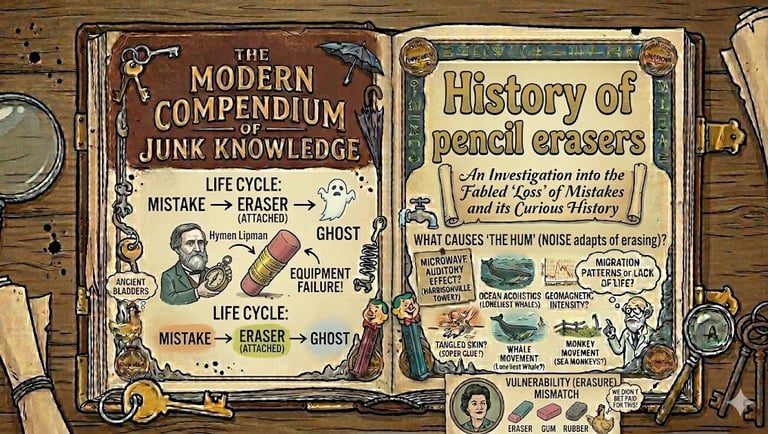
The eraser reached peak "junk" status in 1858 when Hymen Lipman received the first patent for attaching an eraser directly to the end of a pencil. This simple integration changed the "flock" of office supplies forever, turning the pencil into a "two-headed" tool for both creation and destruction.
Fast Facts
The "Pink" Color: Most traditional erasers are pink because of the pumice (volcanic ash) added to the rubber as an abrasive. The specific pink hue originally came from a brand of Italian pumice that was a "junk" byproduct of mining, but it became so iconic that manufacturers now use pink dye to maintain the tradition.
The Ferrule: The little metal band that holds the eraser onto the pencil is called a ferrule. It’s the "boots" of the pencil, keeping the eraser from "chickening out" and falling off during high-pressure corrections.
The Art Eraser: Professional artists often use "kneaded" erasers. These look like gray putty and don't wear down; instead, you "stretch and fold" them to move the graphite inside the material, much like the original bread-ball method.
References
Priestley, J. (1770). A Familiar Introduction to the Theory and Practice of Perspective.
Petroski, H. (1990). The Pencil: A History of Design and Circumstance. Alfred A. Knopf.
Goodyear, C. (1839). Gum-Elastic and Its Varieties.