Hit the Nail on the Head
The Definition
To describe exactly what is causing a situation or problem; to be precisely correct in an assessment or statement. It implies a level of accuracy that is both satisfying and definitive.
The Deep Dive
While many idioms have convoluted, secret histories, this one is refreshingly literal—yet its endurance over two millennia is what makes it "junk knowledge" royalty. It is one of the oldest recorded metaphors in the English language (and its linguistic ancestors).
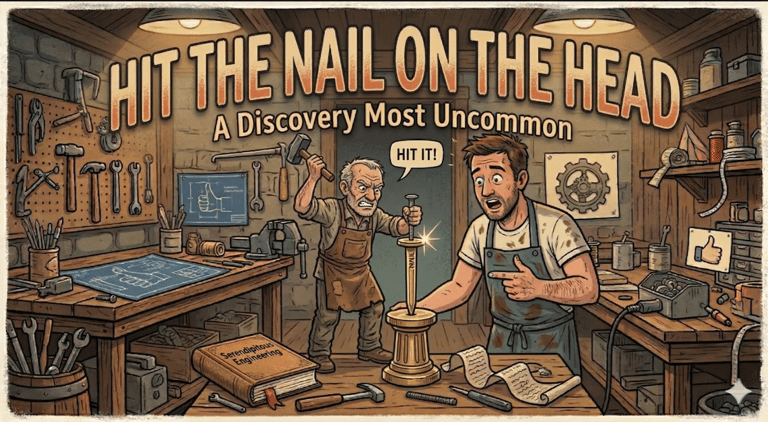
The phrase relies on the physics of manual labor. When driving a nail into wood, there is only one "perfect" strike: a square blow directly onto the flat center of the nail's head.
The Margin of Error: If the hammer strikes even slightly off-center, the nail will bend, the wood will split, or the hammer will "glance off" and potentially strike the carpenter’s thumb.
The Metaphorical Alignment: Just as a perfect hammer strike transfers 100% of the energy into the nail to achieve the goal, "hitting the nail on the head" in a conversation means your words have landed with maximum impact and zero wasted effort.
The phrase has been a staple of human expression since at least the 15th century. It appears in early English translations of the Bible and in the works of 16th-century scholars like Erasmus, who used the Latin equivalent (Rem acu tetigisti—"You have touched the thing with a needle") to describe the same kind of surgical precision.
Fast Facts
The Efficiency: In the days before power tools, "hitting the nail on the head" wasn't just about accuracy; it was about stamina. A carpenter who missed the head frequently would double his workload and ruin his materials.
The "Head" Evolution: Ancient nails didn't always have flat heads; they were often hand-forged "clout nails" with rounded or decorative tops, making the "perfect strike" even harder to achieve.
The Global Standard: This idiom is nearly universal. Similar versions exist in Dutch (De spijker op de kop slaan) and German (Den Nagel auf den Kopf treffen).
References
Erasmus, D. (1500). Adagia. (Early collection of Greek and Latin proverbs).
Hey
wood, J. (1546). A Dialogue Conteinyng the Nomber in Effect of All the Prouerbes in the Englishe Tongue.
Moxon, J. (1678). Mechanick Exercises: Or, the Doctrine of Handy-Works.
Ammer, C. (2013). The Dictionary of Clichés. Skyhorse Publishing.