Hold the Fort
The Definition
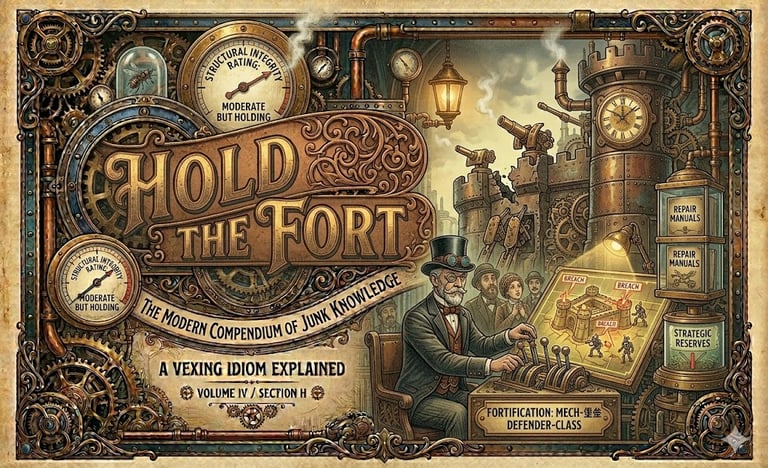
This idiom means to maintain control of a situation or look after a place while others are temporarily away. It implies a sense of responsibility and the need to defend against potential problems or interruptions until the primary "straight arrow" authority returns.
The Deep Dive
The phrase has a surprisingly specific origin rooted in a Civil War battle and was later popularized through a famous gospel hymn.
The Battle of Allatoona: In October 1864, during the American Civil War, Union General William Tecumseh Sherman signaled a message to Brigadier General John M. Corse, who was under heavy attack at Allatoona Pass. The signal—sent via flags from a nearby mountain—was essentially, "Hold out, relief is coming." While the exact words "hold the fort" weren't used in the official dispatch, the sentiment was captured by the press as "Hold the fort; I am coming."
Gospel Popularity: Shortly after the war, the songwriter Philip Bliss turned this dramatic military moment into a popular hymn titled Hold the Fort. The lyrics used the military metaphor to describe spiritual perseverance: "Hold the fort, for I am coming," Jesus signals still. The hymn became a massive hit in both the U.S. and Great Britain, embedding the phrase into the culture as a standard expression for steadfastness.
Modern Office Lingo: Today, the phrase has transitioned from the battlefield to the cubicle. Telling a colleague to "hold the fort" while you grab lunch suggests that even a quiet office can feel like a defensive position when the phones start ringing. It represents a temporary stewardship where the goal is simply to ensure that nothing disrupts the status quo.
Fast Facts
The "Mind the Store" Rival: A similar idiom used primarily in retail and business. While "hold the fort" implies a defensive stance against chaos, "mind the store" suggests a more general supervisory role.
General Sherman's Real Message: The actual signal sent by Sherman was more technical: "Sherman is coming with 20,000 men. Allatoona must be held." The more poetic "hold the fort" was a result of the era's flair for dramatic storytelling.
References
Ammer, C. (2013). The Dictionary of Clichés. Skyhorse Publishing.
Bliss, P. P. (1870). Hold the Fort. (Hymn).
Oxford English Dictionary. (2026). The Civil War Origins of American Idiomatic Command.