Holding the Bag
The Definition
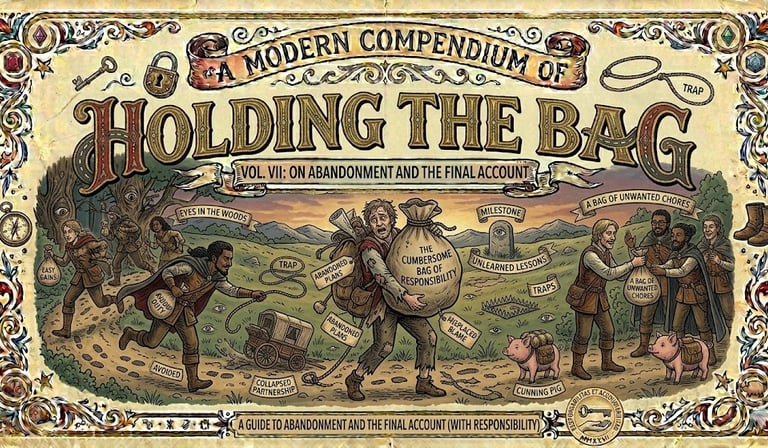
To be "left holding the bag" means to be abandoned by others and left to face the blame, responsibility, or financial loss for a shared situation. It is the realization that your partners have vanished, leaving you as the sole target for consequences.
The Deep Dive
The phrase is a direct linguistic descendant of the [Snipe Hunt] and other "junk" swindles from the early 18th century.
The Snipe Hunt Connection: As explored in our entry on the Snipe Hunt, the "bag" refers to the literal burlap sack or pillowcase held by the victim. While the group pretends to drive the non-existent snipes toward the sack, they actually retreat to safety. The victim is left standing in the dark, "holding the bag" for a catch that will never come.
The Criminal Pivot: By the mid-1700's, the phrase moved into the world of larceny. In a literal robbery, the person holding the bag was the accomplice tasked with carrying the stolen goods while the others kept watch or provided a distraction. If the law arrived, the more nimble thieves would flee, leaving the bag-holder—weighed down by the evidence—to be caught and prosecuted alone.
The Financial "Bagholder": In modern economic "junk" talk, specifically in the stock and crypto markets, a "bagholder" is someone who holds onto a declining asset until it becomes worthless. They are the ones who didn't sell when the "smart money" exited, leaving them holding a "bag" of devalued assets.
Cultural Evolution: The phrase captures a fundamental human fear: being the "chump" who stayed loyal or remained present while everyone else prioritized their own survival. It has evolved from a literal description of a prank or a crime into a universal metaphor for unevenly distributed accountability.
Fast Facts
Early Literature: The phrase appears in British literature as early as 1793 in the works of Thomas Jefferson, who used it to describe political abandonment.
The "Fall Guy": A close relative to this idiom is the "fall guy" or "patsy," though "holding the bag" specifically emphasizes the moment of abandonment.
References
Ammer, C. (2013). The Dictionary of Clichés. Skyhorse Publishing.
Taleb, N. N. (2018). Skin in the Game. (Discussion on accountability and bagholding).
Oxford English Dictionary. (2026). The Evolution of Larceny-Based Idioms in American English.