Honor Among Thieves
The Definition
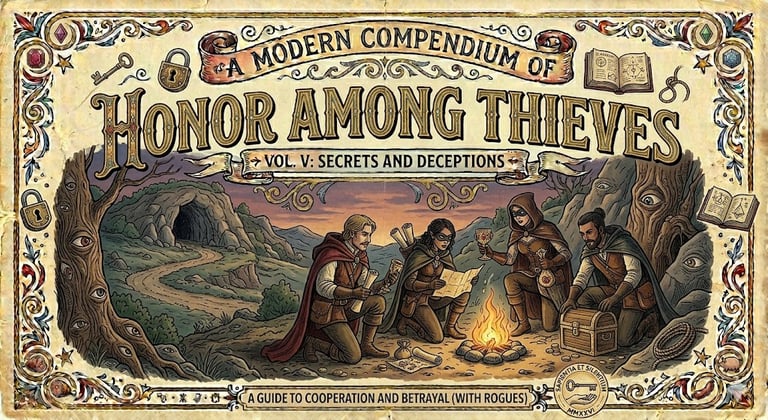
"Honor among thieves" is the sentiment that even criminals—people who lack a moral compass regarding society at large—maintain a strict code of conduct or loyalty toward one another. It implies that within a specific group of outcasts, certain rules must remain sacred to ensure the survival and success of the group.
The Deep Dive
This concept has existed as a philosophical curiosity for millennia, famously explored by Cicero and later popularized in English literature.
The Practical Necessity: While the phrase sounds romantic, its origins are rooted in cold, "junk" pragmatism. A criminal enterprise cannot function if every member is constantly betraying the others. For a heist to work, there must be a baseline of trust regarding the division of loot and the refusal to "snitch" to the authorities. If there were no honor among thieves, the criminal world would collapse into infighting.
The Literary Warning: Interestingly, the phrase is often used ironically or as a challenge. In 1724, Daniel Defoe wrote that "there is no honor among thieves," suggesting that the moment the stakes get high enough or the pressure from the law increases, that supposed loyalty vanishes.
The "Omertà" Connection: In real-world history, this "honor" has been codified into formal systems, such as the Mafia’s code of omertà (silence). These aren't just suggestions; they are enforced through extreme consequences, turning the metaphorical "honor" into a literal life-or-death contract.
Modern Subversion: Today, the phrase is a staple of the "heist movie" genre. It creates a moral complexity where we find ourselves rooting for the "bad guys" because they are loyal to each other, contrasting their internal "honor" with the perceived corruption or coldness of the world outside.
Fast Facts
Ancient Origins: The Roman philosopher Cicero wrote in De Officiis (44 BC) that even those who live by crime and wickedness cannot exist without some grain of justice among themselves.
The "Thieves' Cant": Beyond honor, historical criminal subcultures often developed their own secret languages (Cant) to maintain their internal code and keep outsiders in the dark.
References
Defoe, D. (1724). The History of the Remarkable Life of John Sheppard.
Ammer, C. (2013). The Dictionary of Clichés. Skyhorse Publishing.
Oxford English Dictionary. (2026). The Sociology of Criminal Codes and Informal Justice.