Hook, Line, and Sinker
The Definition
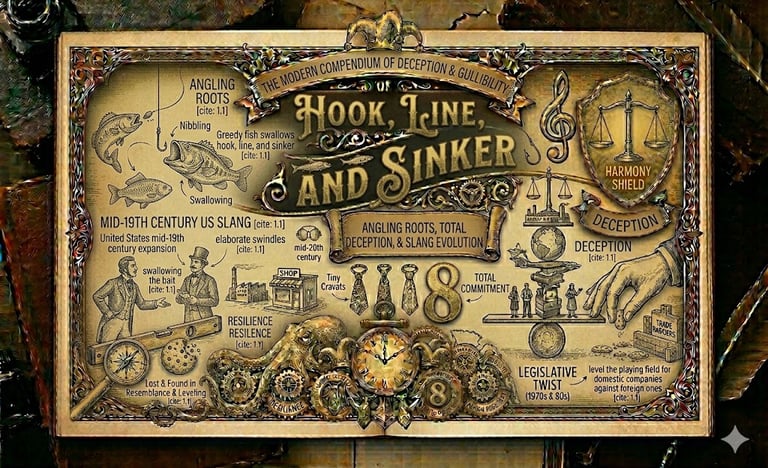
This idiom describes a person who has been completely and utterly deceived. To "fall for it hook, line, and sinker" means to accept a falsehood without any skepticism, swallowing the entire "junk" story as if it were the absolute truth.
The Deep Dive
The phrase is a literal maritime metaphor that moved from the riverbank to the social world in the mid-19th century.
Total Ingestion: The imagery comes from a fish that is so hungry or aggressive that it doesn't just nibble at the bait. Instead, it gulps down the hook (the sharp trap), the line (the cord that leads back to the captor), and the lead sinker (the weight used to keep the bait submerged). When a fish does this, there is no "close shave" or escape; it is entirely caught.
The "Gullible" Transition: By the 1830's, American writers began using the phrase to describe people who were easily swindled. It suggests a level of naivety so profound that the victim ignores every warning sign—the "string" attached to the deal is swallowed along with the promise. It represents a state where a person’s critical thinking has completely "gone to the dogs," leaving them at the mercy of the deceiver.
Modern Deception: Today, the phrase is commonly applied to victims of scams, elaborate pranks, or political propaganda. It highlights the difference between being slightly misled and being one who is totally convinced by a fabrication.
Fast Facts
The "Bait" Connection: While "hook, line, and sinker" refers to the act of being caught, "taking the bait" is the initial moment of falling for a trap.
"Buying It" Rival: A common alternative is saying someone "bought it," implying they paid for a lie with their belief. However, "hook, line, and sinker" conveys a more visual sense of being physically trapped by one's own gullibility.
References
Ammer, C. (2013). The Dictionary of Clichés. Skyhorse Publishing.
Ayto, J. (1990). Dictionary of Word Origins. Arcade Publishing.
Oxford English Dictionary. (2026). Piscatorial Metaphors in 19th-Century American