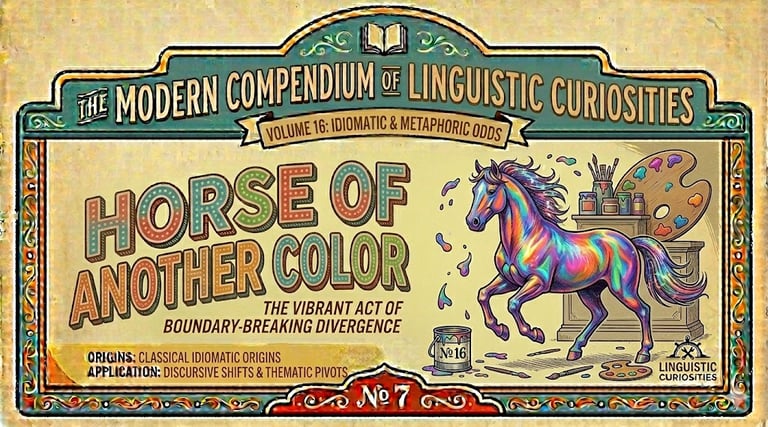
Horse of Another Color
The Definition
This idiom refers to a matter that is entirely different from the one currently being discussed. It highlights a shift in circumstances or facts that changes the nature of a situation, suggesting that while details might look similar, the underlying reality is fundamentally distinct.
The Deep Dive
The phrase is an evolution of a Shakespearean line that originally focused on the similarity of things rather than their differences.
Shakespearean Roots: In Twelfth Night (1601), the character Maria says "My purpose is, indeed, a horse of that colour," meaning her plan is of the same kind as the one being proposed. Over the centuries, the public flipped the phrase to describe a "horse of another color," likely due to the practicalities of horse trading and racing where a difference in color was a primary way to distinguish one animal from another.
The Racing Metric: In the 19th century, horse racing was the ultimate "straight arrow" for distinguishing value. If you were betting on a specific mare and a different horse appeared, the stakes changed instantly. A "horse of another color" became a legal and social shorthand for an entirely new set of rules or a different level of difficulty. It implies that while you may have been prepared for one scenario, the new one is a hard act to follow.
Cinematic Immortality: The idiom was cemented in American pop culture by the 1939 film The Wizard of Oz, which featured a literal "Horse of a Different Color" that changed hues every time the characters looked away. This visual pun reinforced the idea that some things can shift their identity so rapidly that they become a completely different matter.
Fast Facts
"Horse of a Different Color" Rival: This variation is used interchangeably and carries the exact same weight. Both emphasize the total departure from the original subject.
The "Whole New Ballgame" Connection: A modern sporting equivalent that describes a situation where the previous context no longer applies.
References
Shakespeare, W. (1601). Twelfth Night.
Ammer, C. (2013). The Dictionary of Clichés. Skyhorse Publishing.
Oxford English Dictionary. (2026). The Inversion of Literary Idioms in Popular Speech.merican