Hot Mess
The Definition
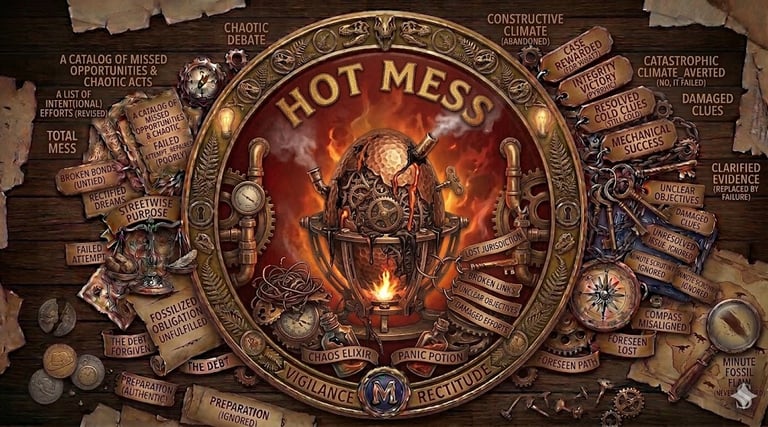
This idiom refers to a person or situation that is spectacularly disorganized, chaotic, or unsuccessful, yet often remains strangely fascinating or even endearing to others. It describes a state of total disarray that is "outside the lines" of normal functioning, where the failure is so complete it becomes a public spectacle.
The Deep Dive
While "hot mess" feels like a product of 21st-century reality television, its linguistic "junk" history stretches back over a hundred years, evolving through several distinct meanings.
The Culinary Origin: In the early 1800's, a "mess" simply referred to a serving of food (often a soft or liquid dish like porridge). A "hot mess" was literally a warm meal. By the late 19th century, the term began to take on a negative connotation, describing food that was unappetizingly mushy or poorly prepared—a literal disaster on a plate.
Southern Vernacular: In the American South during the early 20th century, the phrase shifted from food to people. To call someone a "hot mess" was a way of describing them as a "handful"—someone who was a bit of a disaster but in a colorful or entertaining way. It was often a backhanded compliment, suggesting that while the person was a hard-boiled wreck, they weren't boring.
The Internet Explosion: The phrase underwent a massive resurgence in the mid-2000's, popularized by fashion designers and reality TV personalities. In this modern context, a "hot mess" often refers to someone whose personal life or appearance has "gone to the dogs," but who maintains a certain level of charisma or "train wreck" appeal that makes it hard for the "flock" to look away.
Fast Facts
The "Train Wreck" Rival: While similar, a "train wreck" is usually purely tragic or destructive. A "hot mess" implies a level of style, humor, or absurdity that makes the chaos somewhat more palatable.
The "Dumpster Fire" Connection: This is the 21st-century's more aggressive cousin to the "hot mess," used for situations (like political campaigns or corporate failures) that are not just messy, but actively self-destructing and hazardous.
References
Ammer, C. (2013). The Dictionary of Clichés. Skyhorse Publishing.
Lighter, J. E. (1994). Historical Dictionary of American Slang.
Oxford English Dictionary. (2026). The Evolution of Culinary Terms into Social Pejoratives.