Hula Hoop
The Definition
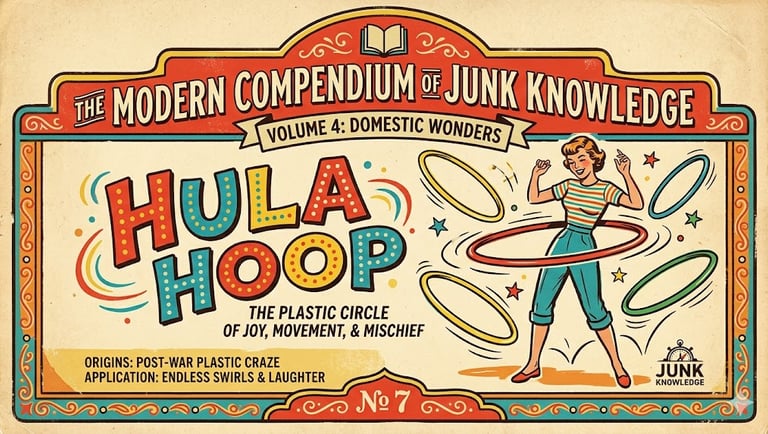
A toy hoop that is twirled around the waist, limbs, or neck by a rhythmic gyrating motion of the hips. While the 1950's plastic version is the most famous, the "hoop" itself is one of the oldest playthings in human history, utilized for both recreation and religious ceremony across multiple continents.
The Deep Dive
The "junk knowledge" behind the Hula Hoop is that it was the world’s first truly global "fad"—a marketing explosion that proved you could sell a basic geometric shape to millions of people if you gave it the right name.
The Ancient "Junk": Long before plastic, the Greeks used grapevines and the Egyptians used dried grasses to make hoops for "hoop rolling" (using a stick to keep the hoop upright while running). In the 14th century, a "hooping" craze hit England so hard that doctors blamed it for heart failure and dislocated backs.
The "Hula" Misnomer: In the 18th century, British sailors visiting the Hawaiian Islands noticed the similarity between the motion of the traditional Hula dance and the "hooping" they had seen back home. They coined the term "Hula Hoop," though the Hawaiians had been doing the motion for centuries as part of a sacred cultural practice, not as a toy.
The Wham-O Revolution (1958): Two American entrepreneurs, Richard Knerr and Arthur "Spud" Melin, heard about children in Australia playing with bamboo hoops. They decided to manufacture them out of a brand-new high-tech "junk" material: Marlex (high-density polyethylene). They gave away free hoops to schools and parks to build "hype," and in just four months, they sold 25 million hoops. It remains the textbook example of a viral product.
The Hula Hoop reached peak "junk" status in the late 1950's when it was banned in several countries (including Japan and Indonesia) for being "indecent" or "subversive." It represents the "junk" of momentum: once the hoop—and the trend—started spinning, it was almost impossible to stop.
Fast Facts
The "Hula Hoop" Space Theory: In the 1960's, a popular urban legend claimed that if a Hula Hoop was spun in the vacuum of space, it would generate enough centrifugal force to shatter a human spine. In reality, NASA astronauts have "taken a load off" by hooping in microgravity; without gravity to pull the hoop down, the motion is actually much easier.
The Record Breakers: The current record for the most Hula Hoops spun simultaneously is 200 (set by Marawa Ibrahim).
The Shoop Shoop Song: The 1960's hit "The Shoop Shoop Song (It's in His Kiss)" originally included lyrics about the Hula Hoop craze, but the references were eventually "given the axe" in favor of more general romantic advice.
References
Steinberg, B. (2011). The Hula Hoop: A History of a Classic Toy.
Wham-O Inc. (2026). The Wham-O Story: From Slingshots to Superballs.
The Strong National Museum of Play. (2026). Inductees: The Hula Hoop.