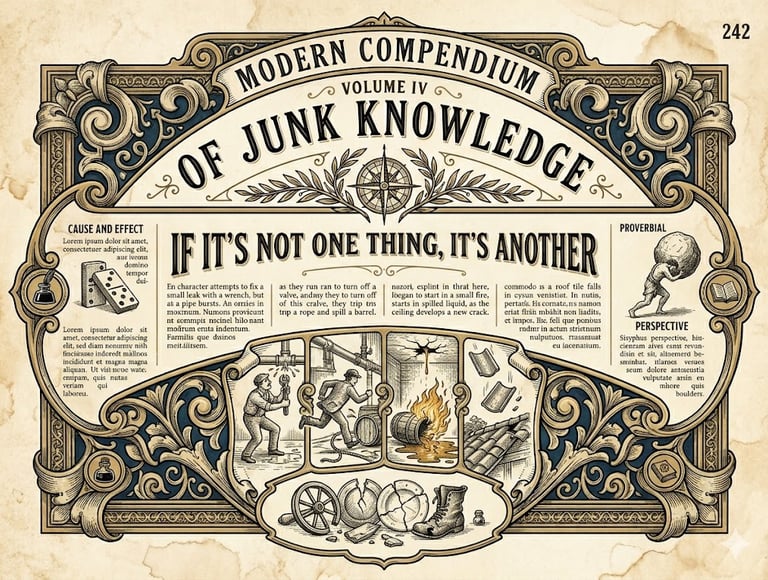
If It's Not One Thing It's Another
The Definition
A weary exclamation used to describe a rapid succession of problems, annoyances, or misfortunes. It suggests that the universe is operating on a "conveyor belt" of trouble: as soon as one issue is resolved, a new, unrelated one immediately takes its place.
The Deep Dive
The "junk knowledge" behind this phrase is its status as the unofficial anthem of the Working Class Stoic. While many idioms seek to find a "silver lining" or a solution, this phrase is purely diagnostic. It acknowledges a specific type of mental fatigue caused not by a single catastrophe, but by the relentless "drip-drip-drip" of minor failures.
The Roseanne Roseannadanna Factor: While the sentiment is centuries old, the phrase was cemented into the American consciousness in the late 1970's by Gilda Radner’s character on Saturday Night Live. Her catchphrase—"It's always something!"—is the spiritual twin to "If it's not one thing, it's another." It transformed a groan of despair into a comedic acknowledgment of life’s absurdity.
The "One Thing" vs. "The Other": Philosophically, the phrase relies on a binary view of bad luck. It implies that "One Thing" (the current problem) is the only barrier to peace. When "The Other" (the next problem) appears, it reveals the illusion of the "One Thing" logic.
The phrase reached peak "junk" status as the definitive "over-the-fence" greeting among neighbors. It serves as a social shorthand for "I am overwhelmed, you are overwhelmed, and we both know that life is a series of small fires that never quite go out." It represents the "junk" of the human condition: the realization that "peace" isn't the absence of problems, but merely the brief interval between them.
Fast Facts
The "Something" Shift: In the UK, the phrase is often delivered as "It's just one thing after another," which leans more toward a chronological list of woes rather than the "A or B" choice implied by the American version.
The Mathematical Misery: Statistically, this phrase is a layman's observation of Murphy’s Law in action—the idea that if anything can go wrong, it will, and usually at the most inconvenient time possible.
The Existential Shrug: Psychologists often view this phrase as a "coping mechanism." By labeling the chaos as a predictable pattern ("one thing or another"), the speaker regains a small sense of control over an otherwise unpredictable day.
References
Radner, G. (1978). Saturday Night Live. (The "Roseanne Roseannadanna" monologues).
Ammer, C. (2013). The Dictionary of Clichés. Skyhorse Publishing.
Taggart, C. (2010). Her Who Must Be Obeyed: The Phrases and Sayings That Make Us Who We Are. Michael O'Mara Books.
The Oxford English Dictionary. (2026). Thing (n.). Oxford University Press.