In a fog
The Definition
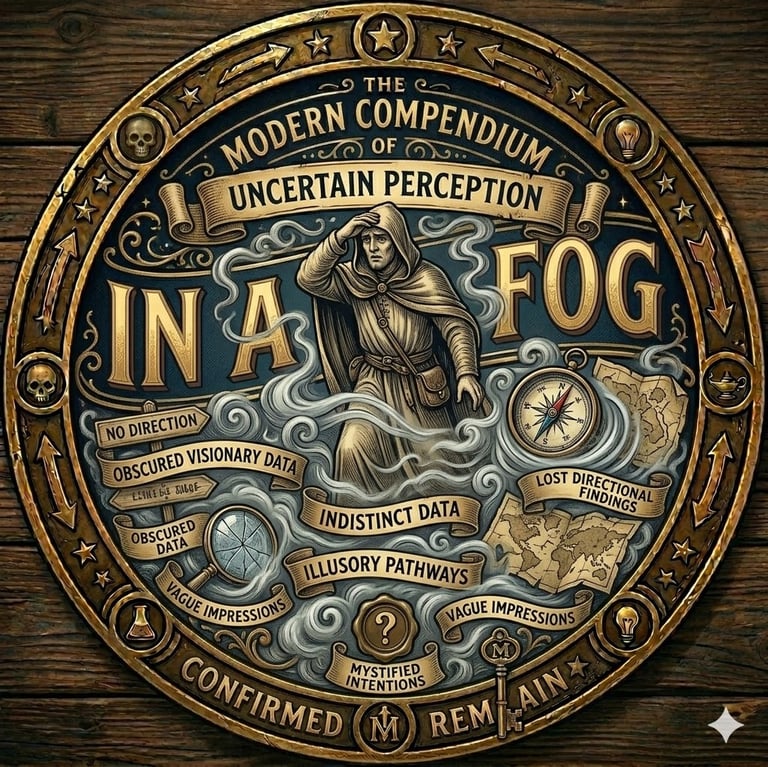
A state of mental confusion, indecision, or dazed detachment. It describes the feeling of being unable to think clearly or see the "path ahead," as if one’s consciousness has been enveloped by a thick, low-lying cloud that obscures all landmarks and logic.
The Deep Dive
The "junk knowledge" behind "In a Fog" is the transition of a deadly maritime hazard into a common office complaint. Before the invention of radar and GPS, a ship entering a fog bank was entering a state of total sensory deprivation.
The Lost Landmark: In the 17th and 18th centuries, sailors relied on "dead reckoning" and visual sightings of the coast. To be "in a fog" meant the literal loss of the horizon. Without a point of reference, the human brain loses its sense of direction and speed, leading to a physical and mental "drift" that is often fatal.
The "Brain Fog" Medicalization: While the idiom has been used poetically for centuries (notably by Charles Dickens to describe the legal confusion of the British courts), it underwent a massive "junk" resurgence in the 21st century. The term "Brain Fog" moved from a casual description of a hangover to a recognized (though unofficial) medical symptom used to describe the cognitive lingering of viral infections and chronic fatigue.
The phrase reached peak "junk" status during the Industrial Revolution, where the literal "fog" of coal smoke in cities like London (the "Pea Soupers") became indistinguishable from the "fog" of bureaucratic complexity. It represents the "junk" of the human mind: the realization that our clarity is entirely dependent on our environment, and when the "atmosphere" changes, our intelligence often vanishes with it.
Fast Facts
The "Fog of War": This famous variant is attributed to the Prussian military theorist Carl von Clausewitz. He argued that commanders can never have perfect information because the chaos and "smoke" of the battlefield create a permanent state of uncertainty.
The London Particular: In 19th-century London, a "fog" was often so thick with soot that it turned yellow or green. Being "in a fog" in Victorian literature often implied being physically trapped in the filth of the city as much as being mentally confused.
The Acoustic Shadow: A curious "junk" fact about being in a literal fog is that it creates "acoustic shadows," where sound can be heard miles away but not by someone standing right next to the source. This physical phenomenon mirrors the mental state of hearing words but failing to process their meaning.
References
Clausewitz, C. von. (1832). Vom Kriege (On War).
Dickens, C. (1852). Bleak House. (The famous opening description of the London fog).
Ammer, C. (2013). The Dictionary of Clichés. Skyhorse Publishing.
The Oxford English Dictionary. (2026). Fog (n.). Oxford University Press.