In a Pickle
The Definition
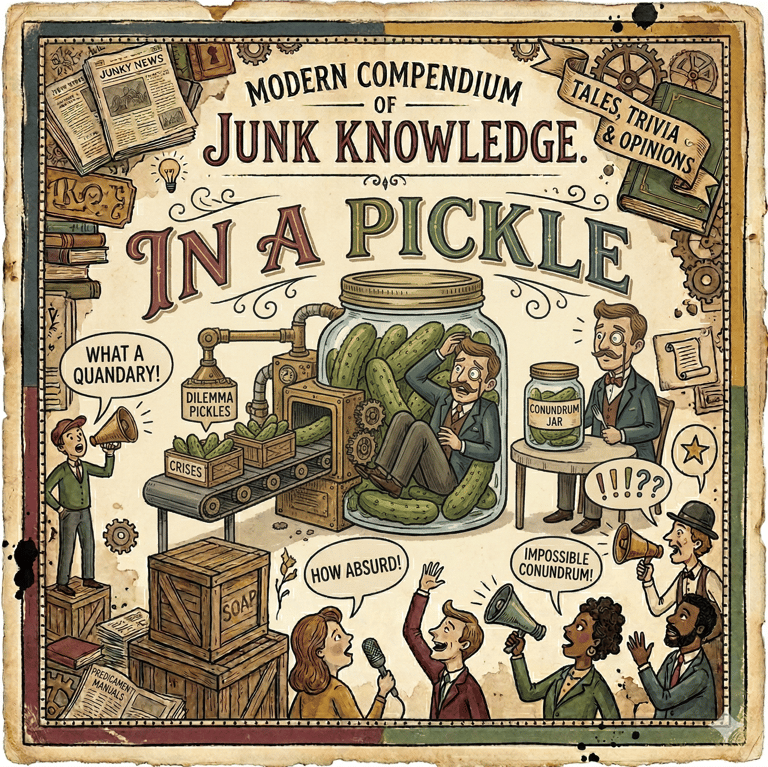
To be in a difficult, messy, or uncomfortable situation from which it is hard to extricate oneself. It implies being "soaked" in trouble, much like a vegetable sitting in a jar of brine.
The Deep Dive
While we now think of a "pickle" as a singular cucumber, the 16th-century "pickle" was a complex, spicy, and often highly acidic sauce or preservative liquid. The "junk knowledge" of this phrase is a rare double-play, involving both a literal culinary observation and a literary heavyweight.
The Preserved State: In the 1500's, to be "in a pickle" was a literal description of meat or vegetables being cleaned, salted, and submerged in vinegar to prevent rot. The metaphor suggested that a person in trouble was being "stewed" or "marinated" in their own misfortune.
The Shakespearean Boost: The phrase was immortalized (and possibly coined in its modern form) by William Shakespeare in The Tempest (1611). In Act 5, King Alonso asks the jester Trinculo, "How camest thou in this pickle?" Trinculo, who is both drunk and physically covered in mud and horse-pond water, replies:
"I have been in such a pickle since I saw you last that, I fear me, will never out of my bones: I shall not fear fly-blowing."
Trinculo’s joke was two-fold: he was "pickled" (drunk) and "pickled" (soaked in filth), which he claimed would preserve him so well that flies wouldn't even try to lay eggs on him ("fly-blowing"). By the 1800's, the "drunken" and "filthy" associations faded, leaving us with the general sense of being "stuck in a sour spot."
Fast Facts
The Dutch Connection: Some etymologists believe the phrase comes from the Dutch in de pekel zitten (to sit in the pickle), a common expression in the 1400's, proving that being "in a jam" is a cross-cultural human constant.
The "Jam" Alternative: While "in a pickle" implies a sour, acidic mess, "in a jam" (an Americanism from the 1880's) implies being physically squeezed or stuck, likely originating from "log jams" in river timber floating.
The Baseball "Pickle": In sports, a "pickle" (or a rundown) occurs when a baserunner is stranded between two bases. They are "preserved" in a state of indecision while the defense closes in.
References
Shakespeare, W. (1611). The Tempest. (Act V, Scene 1).
Tusser, T. (1573). Five Hundred Points of Good Husbandry. (Early culinary usage).
Ammer, C. (2013). The Dictionary of Clichés. Skyhorse Publishing.
The Oxford English Dictionary. (2026). Pickle (n. and v.). Oxford University Press.