In a Tight Spot
The Definition
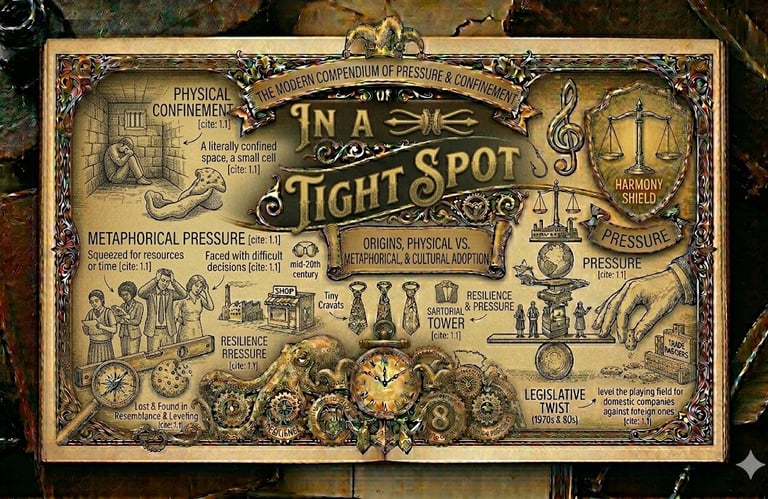
This idiom refers to being in a difficult, dangerous, or precarious situation where choices are limited and escape is difficult. It describes a moment of significant pressure—whether financial, social, or physical—where one must exercise extreme caution to avoid a total "heave-ho" of their circumstances.
The Deep Dive
The phrase is a spatial metaphor for restriction, drawing from various physical experiences of being trapped in a confined space.
Nautical and Spelunking Roots: Historically, the "tight spot" often referred to literal physical confinement. For a sailor, it could mean a ship caught in a narrow channel with no room to maneuver. For a cave explorer, it was a passage so narrow that movement became a test of nerves. By the late 19th century, this physical sensation of being squeezed was adopted into the general lexicon to describe any scenario where one's options were uncomfortably narrow.
The "Straight Arrow" Dilemma: The idiom often implies that the difficulty arises from having to navigate a path that leaves no room for error. When you are in a tight spot, "coloring outside the lines" isn't an option; every move must be precise. It represents a state of being where external pressures are closing in, forcing a person to rely on their wits to find a way out.
Bureaucratic and Financial Squeeze: In the 20th century, the phrase became a common way to describe a lack of resources. A business might find itself in a "tight spot" if its credit is frozen or its supply chain is disrupted. It suggests that while the situation is dire, it is not yet a total disaster—there is still a chance to maneuver if one remains calm.
Fast Facts
The "Between a Rock and a Hard Place" Rival: This is a more extreme version of the idiom, suggesting that not only is the spot tight, but both available options are equally unpleasant.
The "Close Shave" Connection: If you successfully navigate your way out of a tight spot without suffering a major loss, you have experienced a "close shave."
References
Ammer, C. (2013). The Dictionary of Clichés. Skyhorse Publishing.
Ayto, J. (1990). Dictionary of Word Origins. Arcade Publishing.
Oxford English Dictionary. (2026). Spatial Metaphors of Crisis in Industrial English.