In the Limelight
The Definition
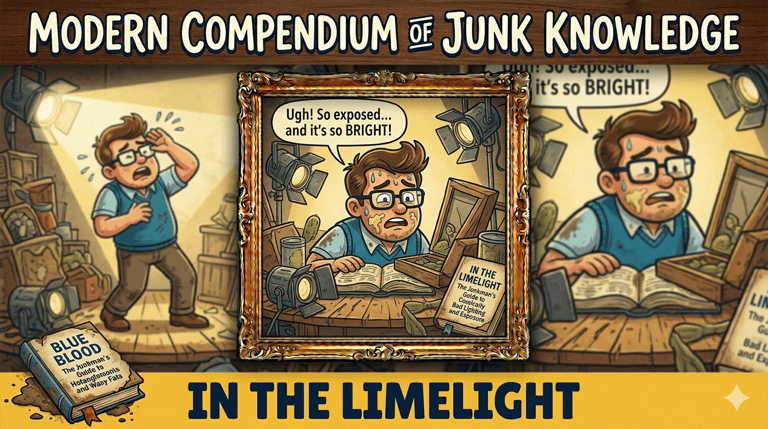
To be at the center of public attention, scrutiny, or fame. It describes a person who is currently the "star" of a particular social or professional moment, often implying a bright, unflattering, or intense focus.
The Deep Dive
The "junk knowledge" behind this phrase is a literal, blindingly bright invention from the 1820's. Before the electric lightbulb, theaters were lit by dim, flickering candles or dangerous oil lamps. The "limelight" was the first true "spotlight," and it was a masterpiece of Victorian chemical engineering.
Invented by Sir Goldsworthy Gurney and later refined by Thomas Drummond, the light was created by directing an intense oxy-hydrogen flame at a cylinder of quicklime (calcium oxide).
The Incandescence: When the lime reached a temperature of approximately 2,400°C, it didn't melt or burn; instead, it began to glow with an incredibly brilliant, white-green light.
The "Spot" Effect: By placing this glowing block of lime inside a metal housing with a lens, stage technicians could direct a concentrated beam of light onto a single performer, leaving the rest of the stage in relative darkness.
To be "in the limelight" was a physical reality for the lead actor or singer. However, the light was notoriously difficult to maintain—a technician (the "lime-lighter") had to constantly rotate the lime cylinder to prevent the flame from burning a hole through it, which would cause the light to sputter and die. By the 1890's, electric arc lamps replaced the chemical version, but the phrase remained as a permanent fixture of our vocabulary for fame.
Fast Facts
The "Lime" in the Light: Despite the name, there were no citrus fruits involved. "Lime" refers to the mineral limestone, from which quicklime is derived.
The Lighthouse Link: Before it hit the stage, Drummond originally intended the limelight to be used in lighthouses and for nighttime surveying across the misty hills of Ireland and Scotland.
The "Green" Tint: While the light was remarkably white for the time, it had a subtle greenish-yellow cast, which some critics claimed made actors look slightly sickly—the original "unflattering" celebrity photo.
References
Gurney, G. (1823). Lectures on Chemical Science. (Early descriptions of the oxy-hydrogen blowpipe).
Drummond, T. (1826). On the Means of Facilitating the Observation of Distant Objects in Geodetical Operations. Philosophical Transactions of the Royal Society.
Reid, A. (2002). The Stage Lighting Handbook. Routledge.
Ammer, C. (2013). The Dictionary of Clichés. Skyhorse Publishing.