Invention of the Stapler
The Definition
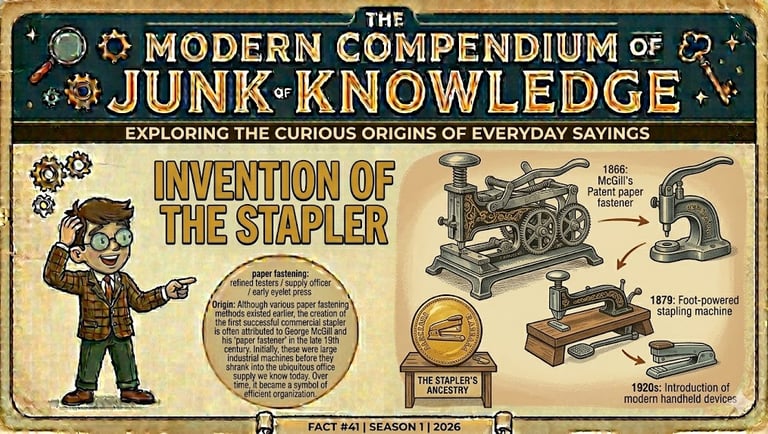
A mechanical device that joins sheets of paper or similar materials by driving a thin metal staple through the layers and folding the ends. While we think of it as a singular invention, the modern stapler is the result of a "collision" between 18th-century luxury craftsmanship and 19th-century industrial efficiency.
The Deep Dive
The "junk knowledge" behind the stapler is that for over a hundred years, the device and the "fastener" were two completely different problems. The early machines were less like office supplies and more like miniature blacksmithing kits for your desk.
The Royal Prototype: Legend has it that the first "stapler" belonged to King Louis XV of France in the 1700's. Each staple was allegedly handmade, engraved with the royal insignia, and used to bind court documents. This was "junk" luxury—a way to show off wealth by literally pinning papers together with custom jewelry.
The "Patent Race" of 1866: The mid-19th century saw a flurry of inventions. George McGill patented a small, bendable brass paper fastener in 1866, but it required a separate machine to punch the hole. That same year, the Novelty Mfg Co. patented a device that could actually drive a staple, but it could only hold one staple at a time. You had to reload after every single click—a tedious process that made "stepping into someone's boots" look easy by comparison.
The "Hotchkiss" Standard: The real breakthrough came in 1895 with the E.H. Hotchkiss Company. They used a long strip of staples held together by a thin coating of glue (or "frozen" together). This allowed for continuous stapling without reloading. In fact, for decades, people in Japan didn't call the device a stapler; they called it a “hottchikisu”.
The stapler reached peak "junk" status in the 1930's with the Swingline Speed Stapler #4. This was the first model where the top opened up completely, allowing you to simply drop in a fresh strip of staples. This "open-loading" design is the "DNA" of almost every stapler sitting on a desk today.
Fast Facts
Staple-less Staplers: In 1910, the "Bump Paper Fastener" was invented. It didn't use metal at all; instead, it cut a tiny flap in the paper and tucked it into a slit. It was a "clean" way to bind, but it couldn't handle the "load" of more than a few pages.
The Surgical Stapler: Invented by Hungarian surgeon Hültl Dezső in 1908, the first surgical stapler weighed eight pounds and took two hours to assemble. It was a massive piece of "junk" that eventually evolved into the sleek, stainless steel tools used in modern operating rooms.
The "Red Swingline" Myth: The famous red stapler from the movie Office Space didn't actually exist in that color. The prop department spray-painted a standard Swingline for the film. Due to public demand, Swingline was forced eventually to release an official red version.
References
McGill, G. W. (1866). U.S. Patent No. 56,587: Paper-Fastener.
The Early Office Museum. (2026). History of the Stapler and Paper Fastener.
Hotchkiss, E. H. (1895). The Hotchkiss No. 1 Catalog.