Irish Goodbye
The Definition
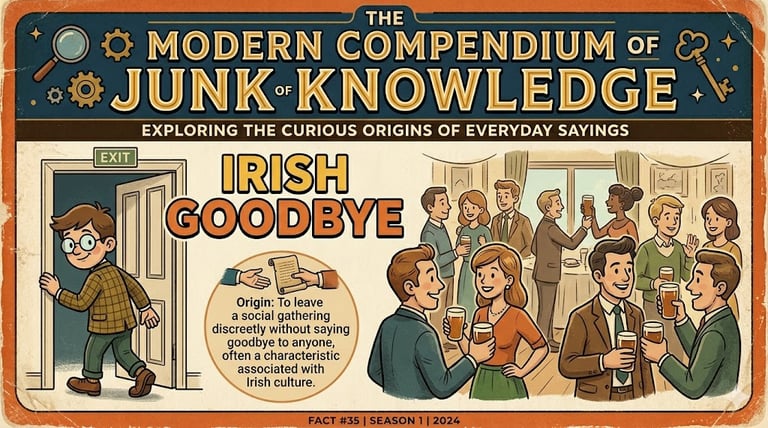
Also known as the "French Leave," the "Dutch Exit," or the "Ghosting," this is the act of leaving a social gathering—such as a party, bar, or wedding—without notifying the host or formally saying goodbye to the other guests. It is the art of the silent disappearance, executed to avoid the prolonged, repetitive, and often awkward ritual of the "long goodbye."
The Deep Dive
The "junk knowledge" behind the Irish Goodbye is that its various names reflect centuries of European cultural rivalries. In the world of idioms, "the other guy" is usually the one blamed for being rude.
The French Connection: In the 18th century, English speakers called it "Taking French Leave." At the time, the French were seen by the British as the height of social impropriety. Conversely, the French called the same move filer à l'anglaise ("to leave like the English").
The Irish Origin Myth: There is no definitive proof that Irish people are more likely to vanish from parties. However, one popular (if speculative) theory suggests it originated during the Great Famine or periods of heavy emigration. Leaving without a formal goodbye was a way to avoid the crushing emotional weight of a "last" farewell when one might never see their family again.
The Modern Social Hack: In the 21st century, the Irish Goodbye has been rebranded as a mercy move. Social commentators argue that in a large party, the "formal goodbye" is actually selfish; it forces the host to stop what they are doing and triggers a "domino effect" where other guests realize how late it is and begin to leave as well. By ghosting, you allow the party to continue undisturbed.
The Irish Goodbye reached peak "junk" status in the era of the "introvert meme." It represents the "junk" of social etiquette: the realization that sometimes the most polite thing you can do is pretend you were never there at all.
Fast Facts
The "Midwest Goodbye" Contrast: The Irish Goodbye is the polar opposite of the "Midwest Goodbye," a grueling multi-stage process involving standing by the door for 45 minutes, talking through the open car window, and finally waving until the car is out of sight.
The Religious Theory: Some suggest the term "Irish Goodbye" became popular in 20th-century America as a jab at Irish-Catholic families, implying they were "slipping out" of social events to head to early morning Mass or to avoid the judgment of the parish priest.
The Celebrity Choice: Professional athletes and celebrities are frequent practitioners of the Irish Goodbye. It allows them to attend high-profile events without becoming trapped in a "photo-and-handshake" line at the exit.
References
Ammer, C. (2013). The Dictionary of Clichés. Skyhorse Publishing.
Grammarist. (2026). Irish Goodbye: Origin and Meaning.
Etymonline. (2026). French Leave (n.).