It Never Rains But It Pours
The Definition
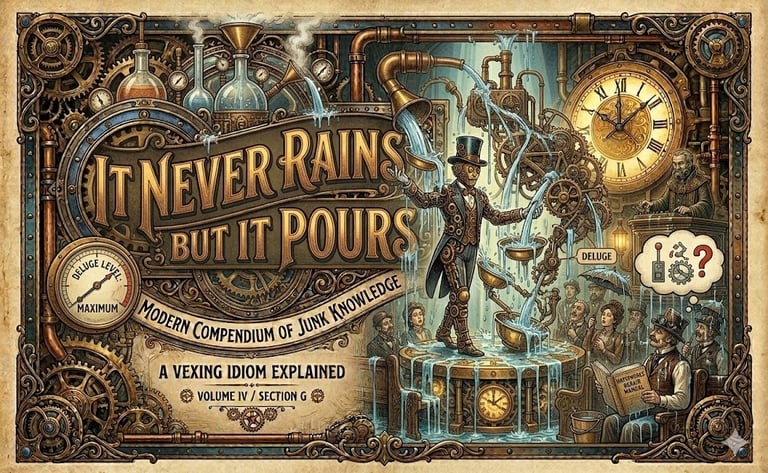
This idiom suggests that when things go wrong, they tend to go wrong in quick succession or all at once. It describes a situation where a single unfortunate event is immediately followed by several others, creating a hot mess of complications that can feel overwhelming.
The Deep Dive
The phrase evolved from an 18th-century literary observation into a piece of universal "junk knowledge" about the nature of bad luck.
Literary Origins: The expression is attributed to Queen Anne’s physician, John Arbuthnot, who used it as the title of a 1726 book. It was later popularized by the writer Jonathan Swift. Originally, it was an observation about English weather—which often shifts from a light drizzle to a torrential downpour without warning—but it quickly became a metaphor for the human experience.
The Saturated State: The metaphor relies on the idea of saturation. A light rain is manageable, but a "pour" creates a spot where the ground can no longer absorb the water, leading to flash floods. In life, this represents the moment when a person’s ability to "hold the fort" is compromised because they are being hit by too many stressors simultaneously.
The "Junk" of Superstition: Throughout the 19th and 20th centuries, the phrase became a staple of folk wisdom. It suggests that misfortune has a gravitational pull; once one "wrench in the works" appears, it somehow invites others. While modern probability suggests this is often just a cluster of random events, the idiom remains a powerful way to express the feeling of being targeted by fate.
Fast Facts
The Morton Salt Connection: In 1911, Morton Salt famously flipped this idiom on its head with the slogan "When it rains, it pours." This was a "hard-boiled" marketing move to promote their free-flowing salt, which—unlike competitors'—wouldn't clump in damp weather.
Global Variations: Many cultures have a version of this sentiment. In Spain, they might say Las desgracias nunca vienen solas (Misfortunes never come alone), reinforcing the idea that bad luck travels in groups.
References
Arbuthnot, J. (1726). It Cannot Rain but it Pours.
Ammer, C. (2013). The Dictionary of Clichés. Skyhorse Publishing.
Oxford English Dictionary. (2026). Meteorological Metaphors in 18th-Century Satire.