It’s Raining Cats and Dogs
The Definition
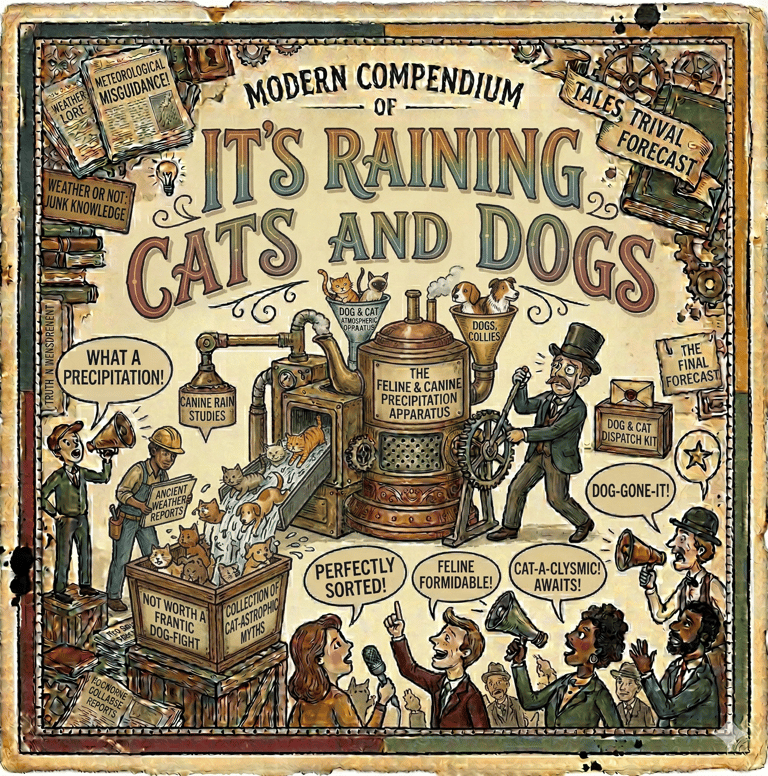
To rain extremely heavily; a "downpour" of such intensity that it feels as though the sky is discharging solid objects. It is the ultimate English idiom for a "monsoon" in a tea-cup.
The Deep Dive
This is perhaps the most "junk-heavy" entry in the English language, with theories ranging from Norse mythology to the physics of 17th-century sanitation.
The Thatch-Roof Trap (The "Junk" Legend): The most popular—and scientifically debunked—theory claims that in the 1500's, houses had thatched roofs where cats, dogs, and other small animals would sleep to stay warm. When it rained heavily, the thatch became slippery, and the animals would "fall" off the roof, making it look as though it were "raining cats and dogs." In reality, a thatched roof is thick, dry, and surprisingly sturdy; no self-respecting dog would sleep on a steep, unstable pile of straw in a storm.
The Urban Flash Flood (The Reality): The true origin is likely much grimmer. In 17th-century cities like London, drainage systems were narrow, open gutters in the middle of the street. During a massive downpour, these gutters would turn into raging torrents. Because stray animals often succumbed to the elements or drowned in the rising water, their bodies would be washed down the streets in the aftermath of a storm.
The Swift Description: In 1710, Jonathan Swift (author of Gulliver's Travels) wrote a poem called A Description of a City Shower, where he described the gruesome sight of "drowned puppies" and "dead cats" being swept away by the rain. To the 18th-century eye, it literally looked as if the rain had brought the animals with it.
The phrase was further popularized by Swift in his 1338 work Polite Conversation, where he used the exact wording: "I know Sir John will go, though he was sure it would rain cats and dogs." It has remained the standard for a "deluge" ever since.
Fast Facts
The Odin Connection: Some "junk" historians point to Norse mythology, where Odin (the god of storms) was often accompanied by dogs (symbols of wind) and cats (symbols of rain). However, there is no direct linguistic link from Old Norse to this specific 17th-century English idiom.
The "Cata Dupa" Theory: A more academic (but less likely) theory suggests it’s a corruption of the Greek kata doupa, meaning "contrary to expectations" or "with a heavy sound," referring to the cataracts of the Nile.
Global Variations: In Wales, they say "it's raining old women and sticks." In France, "it's raining like a peeing cow" (il pleut comme vache qui pisse).
References
Swift, J. (1710). A Description of a City Shower. (The Tatler).
Swift, J. (1738). A Complete Collection of Genteel and Ingenious Conversation.
Ammer, C. (2013). The Dictionary of Clichés. Skyhorse Publishing.
The Oxford English Dictionary. (2026). Rain (v.) and Cat (n.1). Oxford University Press.