Ivan Krylov’s Fable
The Definition
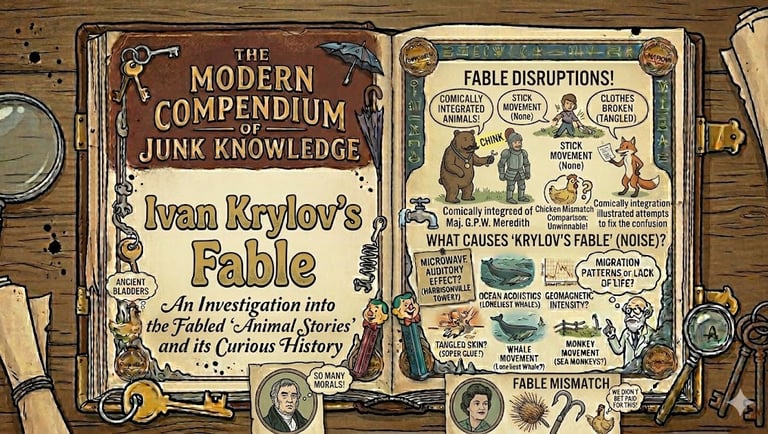
A famous 1814 fable by the "Russian La Fontaine," Ivan Krylov. While Krylov wrote hundreds of fables, this specific story gave the world one of its most essential "junk knowledge" idioms: "The Elephant in the Room."
The Deep Dive
The "junk knowledge" behind Krylov’s fable is that it describes a psychological phenomenon we all experience: the ability to obsess over "junk" while ignoring a massive, undeniable reality.
The Plot: A man visits a natural history museum and spends hours marveling at the tiny details of the exhibits. He describes seeing "insects no larger than a dust mote," "ladybirds," and "tiny beetles" with incredible precision. He is a master of the "micro-junk."
The Punchline: When a friend asks him what he thought of the elephant, the man freezes. He admits that he never even noticed it. He was so busy "sticking his nose in" the display cases of beetles that he completely missed the largest animal in the building.
The "Elephant" Evolution: While Krylov wrote the fable in 1814, the English idiom "The Elephant in the Room" didn't fully take off until the mid-20th century. It represents the "junk" of human focus: our tendency to ignore the "big, gray" obvious problem (like a failing business or a global solar storm) because it’s easier to talk about the "ladybirds" of minor details.
The fable reached peak "junk" status in the world of modern therapy and corporate management. It represents the "junk" of avoidance: the "Elephant" is the uncomfortable truth that "kith and kin" refuse to acknowledge because "what’s done is done."
Fast Facts
The Russian Aesop: Ivan Krylov was a librarian by trade. He didn't start writing fables until he was 40, proving that you’re never too "long in the tooth" to start a new.
The Social Commentary: In 19th-century Russia, Krylov’s fables were a way to "chicken out" of direct political criticism. By using animals, he could mock the Tsar’s bureaucracy without "getting the axe" from the censors.
The Scientific Parallel: This is a literary version of Inattentional Blindness. In the famous "Gorilla Experiment," people focused on counting basketball passes completely fail to see a man in a gorilla suit walk through the middle of the screen. We are all Krylov’s inquisitive man.
References
Krylov, I. A. (1814). The Inquisitive Man (Lyubopytniy).
Pares, B. (1926). Krylov’s Fables. Jonathan Cape.
Chabris, C., & Simons, D. (2010). The Invisible Gorilla. Crown.