Join the Club
The Definition
A sarcastic or weary expression of solidarity. It is used when someone complains about a problem, only to realize that the person they are talking to is suffering from the exact same misfortune. It implies that the "club" of people dealing with this particular brand of nonsense is already quite large.
The Deep Dive
This is a "high-society" piece of junk knowledge from the golden age of London Gentlemen's Clubs (c. 1850–1910). While we now use it when two people both have a flat tire, the origin is a literal, exclusive social structure.
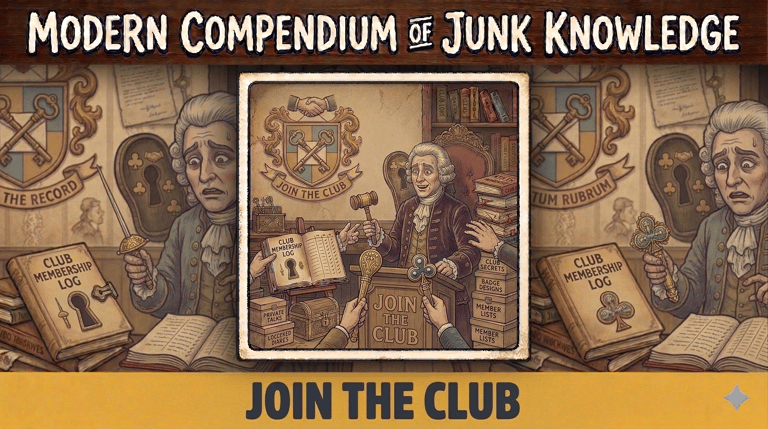
In 19th-century London, "joining the club" was the ultimate goal of any ambitious man. Clubs like the Reform, the Athenaeum, or White’s were private sanctuaries where members could escape the chaos of the city.
The Paradox of Exclusivity: To join a prestigious club, you had to be "vetted" by existing members. If even one member "blackballed" you (by dropping a black ball into a voting box), you were out.
The "Misery" Shift: Around the 1880's, the phrase began to be used ironically. When a person faced a common, annoying social obligation or a financial setback, their peers would say, "Welcome to the club" or "Join the club."
The Shared Burden: It suggested that certain problems—like being nagged by a landlord, catching a seasonal cold, or failing to understand a new piece of technology—were so universal that anyone experiencing them was "automatically enrolled" in a massive, unwanted organization of fellow sufferers.
The phrase exploded in popularity during World War I, as soldiers in the trenches used "Join the club" as a grimly humorous response to any new recruit complaining about the mud, the food, or the lack of sleep. By the time it reached 1950's sitcoms, it had lost its aristocratic roots and became the universal shorthand for "you’re not alone in your misery."
Fast Facts
The "Blackball" Link: This is a linguistic cousin to being "blackballed" or "blacklisted," both of which refer to the voting systems used by the very clubs that inspired the idiom.
The "Club" as Weapon: Before it was a social group, a "club" was a heavy stick (from the Old Norse klumba). There is a bit of linguistic "junk" irony in the fact that we now "join" a club to find safety from the metaphorical "blows" of life.
The First Print: While the concept of a club is ancient, the sarcastic "Join the club!" as a standalone response didn't become a common literary trope until the early 20th century.
References
Dickens, C. (1836). The Pickwick Papers. (On the nature of social clubs).
Ammer, C. (2013). The Dictionary of Clichés. Skyhorse Publishing.
Flexner, S. B. (1982). Listening to America. Simon & Schuster.
The Oxford English Dictionary. (2026). Club (n. and v.). Oxford University Press.