Jump Ship
The Definition
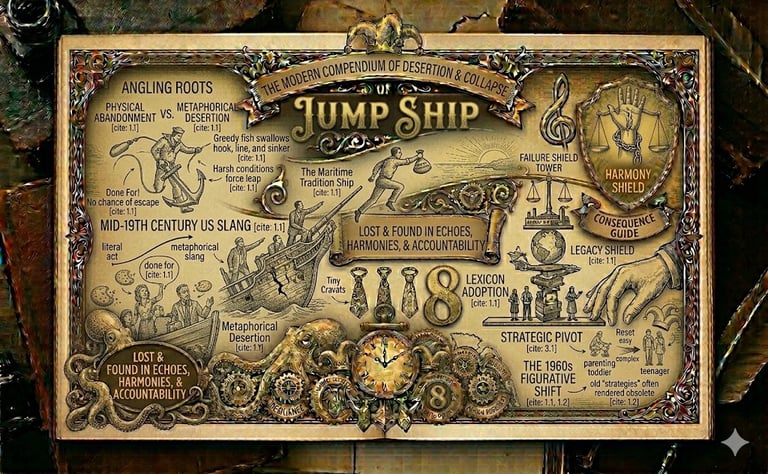
This idiom means to abandon a project, organization, or commitment, typically when it appears to be failing or when a better opportunity arises elsewhere. It implies a sudden departure—often seen as a desertion—to avoid being caught in a hot mess or a sinking situation.
The Deep Dive
Like many of the most enduring idioms in the "junk knowledge" collection, this phrase was born on the high seas, where leaving your post was more than just a career move; it was a matter of life or death.
Literal Desertion: Historically, "jumping ship" was the act of a sailor literally leaping into the water or onto a dock to escape their service. In the 18th and 19th centuries, naval life was often a hard-boiled existence of poor rations and harsh discipline. Sailors who found the conditions unbearable or feared a shipwreck would "jump ship" at the first available port. Because they were often under contract, this was a criminal act of desertion.
The "Sinking" Instinct: There is also a strong connection to the biological "junk" instinct of survival. The phrase is frequently used in conjunction with the observation that "rats jump a sinking ship." Legend has it that rats, possessing a keen sense for structural failure, would flee a vessel long before the human crew realized they were in over their heads. This gave the idiom a secondary meaning: leaving not just out of choice, but out of a desperate need to survive a doomed endeavor.
Modern Career Pivot: Today, the phrase has been sanitized for the corporate world. When an executive leaves a struggling company for a competitor, they are said to have "jumped ship." While it no longer carries a prison sentence, it still retains a hint of betrayal or a lack of loyalty to the original "crew."
Fast Facts
The "Golden Parachute" Contrast: While "jumping ship" implies a frantic or self-initiated exit, a "golden parachute" is a pre-negotiated, lucrative exit strategy for executives, ensuring they don't get wet when they finally leave the vessel.
Legal Stakes: In the age of sail, "jumping ship" in a foreign port often meant the sailor had to live "outside the lines" of society to avoid being caught by bounty hunters and returned to their captain for punishment.
References
Ammer, C. (2013). The Dictionary of Clichés. Skyhorse Publishing.
Dana, R. H. (1840). Two Years Before the Mast.
Oxford English Dictionary. (2026). The Maritime Origins of Professional Desertion.