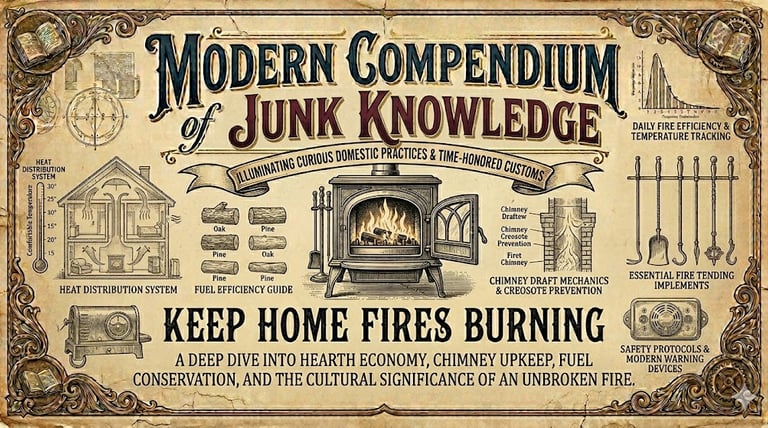
Keep Home Fires Burning
The Definition
A patriotic and sentimental idiom meaning to maintain a sense of normalcy, warmth, and continuity at home while others are away—typically at war or working far from their families. it is a commitment to keeping the "spirit" of a household alive so that there is something worth returning to.
The Deep Dive
The "junk knowledge" behind "keep the home fires burning" is that it isn't just an ancient hearth-side proverb; it was a global propaganda masterstroke designed to prevent domestic morale from collapsing during World War I.
The Song that Defined a Generation: The phrase was immortalized by the 1914 song "Keep the Home Fires Burning (Till the Boys Come Home)," written by Ivor Novello with lyrics by Lena Guilbert Ford. Released just as the "Great War" began, it became the definitive anthem for the British and American home fronts. It reframed the grueling, lonely labor of those left behind—mostly women—as a vital military "duty."
The Literal Hearth: In the early 20th century, homes were heated by coal or wood. Keeping a fire burning wasn't a metaphor; it was a constant, dirty, and physically demanding job. If the fire went out, the pipes froze, the food rotted, and the "soul" of the house literally went cold. To "keep the fire" was to preserve the physical infrastructure of the family.
The "Hestia" Connection: The concept taps into the ancient Greek worship of Hestia, the goddess of the hearth. In antiquity, the "public hearth" of a city was never allowed to go out; if it did, it was seen as a sign that the city had lost its connection to the gods and its own identity. "Keeping the home fires" is the modern, secular version of this sacred flame.
The phrase reached peak "junk" status during the 1940's, as it was revived for World War II to remind civilians that their "quiet" lives were the very thing the "flock" was fighting to protect. It represents the "junk" of emotional endurance: the belief that as long as the light is on, the story isn't over.
Fast Facts
The "Porch Light" Evolution: In modern suburban America, the practice of "keeping a light on" for someone (popularized by the Motel 6 ad campaign: "We'll leave the light on for you") is the direct descendant of the home fire. It’s a signal of welcome and safety in a dark world.
The Tragic Lyricist: Lena Guilbert Ford, who wrote the lyrics to the famous song, died in an air raid in London in 1918. She was one of the first civilian casualties of the very war she helped the world endure through her words.
The "Ashes" Warning: Just as "scattered to the winds" represents the end of a home, "keeping the fires burning" represents its survival. If the fires are neglected, the home becomes a "cold site"—a place that is physically present but emotionally dead.
References
Novello, I., & Ford, L. G. (1914). Keep the Home Fires Burning (Till the Boys Come Home). Ascherberg, Hopwood & Crew, Ltd.
Fussell, P. (1975). The Great War and Modern Memory. Oxford University Press.
The Imperial War Museum. (2026). Music and Morale on the Home Front.