Keeping up with the Joneses
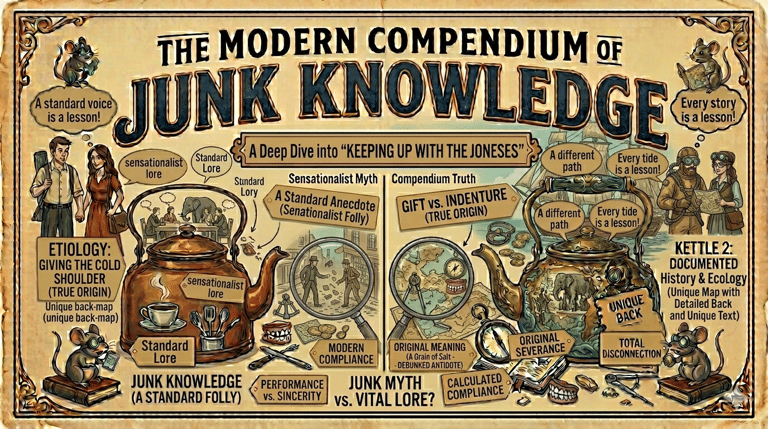
The Definition
The social comparison of oneself to one's neighbors as a benchmark for social class or the accumulation of material goods. It describes the exhausting, often fruitless cycle of acquiring newer, better things simply because those around you have done so.
The Deep Dive
This is a literal piece of "junk knowledge" from the golden age of the American Sunday Funnies. While the sentiment of envy is as old as humanity, the specific name "Jones" was chosen because it was the most common surname in the United States, representing the "average" yet unattainable standard of success.
The Comic Strip: The phrase was coined by cartoonist Arthur R. "Pop" Momand. In 1913, he launched a comic strip titled Keeping Up with the Joneses in The New York World.
The Invisible Neighbors: In a brilliant bit of satirical "junk" writing, the Jones family never actually appeared in the comic. The story focused on the McGinis family, who constantly struggled, fretted, and went into debt trying to match the lifestyle of the neighbors they could never quite see.
The Personal Origin: Momand based the strip on his own life. He and his wife lived in a high-class community in Cedarhurst, New York, on a salary that didn't match their neighbors'. He later admitted, "We were living way beyond our means to keep up with the people around us. I realized there were millions of others doing the same thing."
The strip ran for 28 years and was so popular that the title moved from the newspaper page into the American lexicon by the 1920's. It became the defining metaphor for the consumerism of the "Roaring Twenties" and the later suburban explosion of the 1950's.
Fast Facts
The Real Joneses: Some "junk" historians suggest the phrase refers to the wealthy Edith Wharton (née Jones) family in New York, whose lavish lifestyle set the bar for the Gilded Age. While the Wharton family was certainly influential, the comic strip is the documented source of the idiom.
The "Conspicuous Consumption" Link: This is the sociological cousin to the term "Conspicuous Consumption," coined by Thorstein Veblen in 1899 to describe the waste of money to enhance one's prestige.
Global Variations: In the UK, a similar sentiment is often expressed as "" (made famous by the sitcom of the same name), though that focuses more on social etiquette than just material goods.
References
Momand, A. R. (1913–1941). Keeping Up with the Joneses. (Associated Newspapers).
Veblen, T. (1899). The Theory of the Leisure Class.
Ammer, C. (2013). The Dictionary of Clichés. Skyhorse Publishing.
The Oxford English Dictionary. (2026). Jones (n.). Oxford University Press.