Keeping Your Nose to the Grindstone
The Definition
To "keep your nose to the grindstone" means to work extremely hard and for long periods, often on repetitive or grueling tasks. It implies a level of focus and a total commitment to the job at hand, usually to the exclusion of any leisure or distraction.
The Deep Dive
There are two competing historical theories for this idiom, both of which involve the literal physical proximity required by dangerous or delicate labor.
The Miller’s Theory: In traditional flour mills, a miller had to keep a constant eye—and nose—on the massive spinning millstones. If the stones were set too close together, they would create friction and heat, potentially scorching the flour. A miller would lean down to "smell the stone" to detect the scent of burning grain or overheated stone. A smell of smoke meant the operation had to be stopped immediately to avoid a fire.
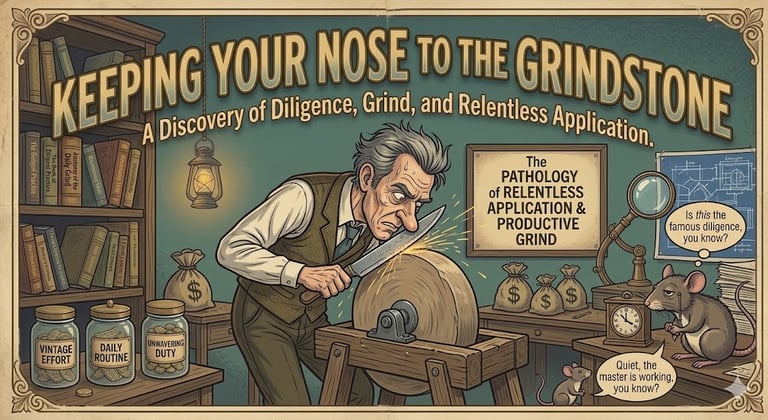
The Tool-Grinder’s Theory: The more widely accepted origin comes from the cutlery and tool-making industries. Grinders used a large, rotating stone wheel to sharpen blades. To achieve the perfect edge, the worker had to lean over the wheel, holding the metal against the stone with intense concentration. Because of the angle required for precision, the worker's face—and nose—would be positioned just inches above the spinning wheel. If they looked away or "lifted their nose," the edge would be ruined or, worse, the blade could catch and cause an injury.
Modern Endurance: By the 19th century, the literal physical position became a metaphor for anyone in a demanding profession. It captures the essence of a "grind"—the slow, steady, and often abrasive process of working toward a goal.
Fast Facts
Early Records: The phrase is exceptionally old, appearing in various forms as early as the 1530's in John Frith's A Mirroure or Glasse to Know Yourself.
The "Grind" Etymology: The word "grind" itself has been used as a synonym for hard work or a difficult student (a "grind") since the mid-1800's.
References
Ammer, C. (2013). The Dictionary of Clichés. Skyhorse Publishing.
Ayto, J. (1990). Dictionary of Word Origins. Arcade Publishing.
Oxford English Dictionary. (2026). The Mechanics of Pre-Industrial Tool Sharpening in English Idioms.