Kick the Bucket
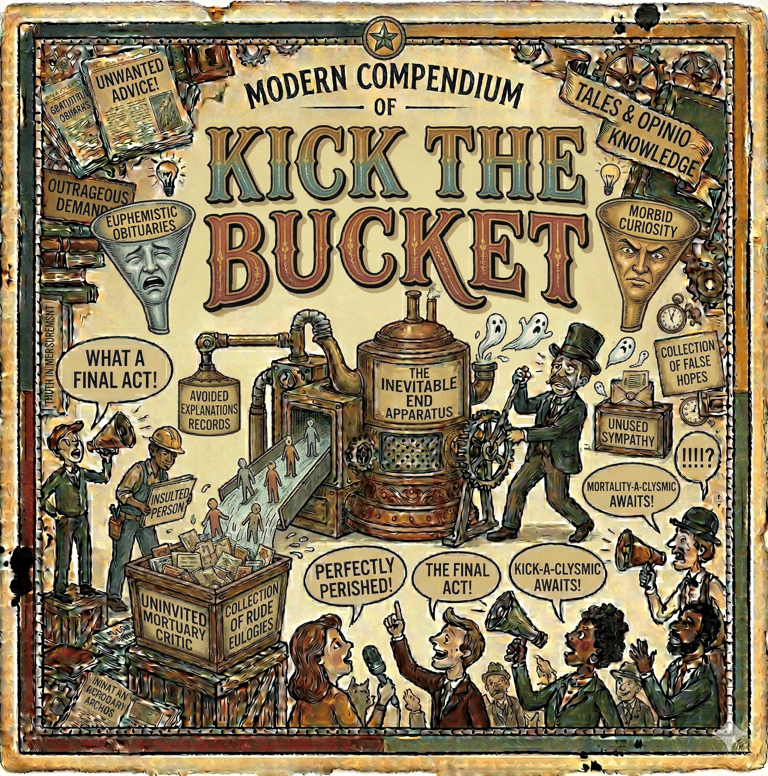
The Definition
A common, somewhat irreverent euphemism for dying. It implies a sudden or definitive end to one's life, often used in a casual or dark-humored context.
The Deep Dive
This is a "high-tension" piece of junk knowledge that pits a gruesome industrial reality against a popular, albeit darker, urban legend.
The "Bucket" (The Reality): The most likely origin has nothing to do with a plastic pail. In 16th-century Norfolk, England, a "bucket" (from the French buquet) was a heavy wooden beam used in slaughterhouses. Pigs would be hung by their hind legs from this beam to be processed. As the animal died, its nerves would spasm, causing its legs to literally "kick the bucket" (the beam) above it.
The "Stool" (The "Junk" Legend): A more cinematic, but less linguistically supported, theory suggests the "bucket" refers to a person standing on an overturned pail with a noose around their neck. By "kicking the bucket" away, they would end their own life. While a vivid image, the term was used in the slaughterhouse sense long before it became a popular description for suicide.
The phrase entered the written record in 1785 in Francis Grose’s Dictionary of the Vulgar Tongue. Grose defined it simply: "To kick the bucket; to die." By the 19th century, it had lost its association with the butcher’s beam and became a standard, if blunt, way to describe the "final exit."
Fast Facts
The "Bucket List": This modern term (referring to things to do before you "kick the bucket") didn't actually exist until the 2007 film of the same name. It is a rare example of an idiom working backward from a movie title into the general lexicon.
The "Pale" Comparison: This is a linguistic cousin to "turning pale" or "passing the pale," though those refer to the color of death rather than the mechanics of the "kick."
Global Variations: In German, you don't kick a bucket; you "give up the spoon" (den Löffel abgeben). In French, you "eat the dandelions by the root" (manger les pissenlits par la racine).
References
Grose, F. (1785). A Classical Dictionary of the Vulgar Tongue.
Ammer, C. (2013). The Dictionary of Clichés. Skyhorse Publishing.
The Oxford English Dictionary. (2026). Bucket (n.1). Oxford University Press.
Forby, R. (1830). The Vocabulary of East Anglia. (On the Norfolk "buquet").