Kick Up Your Heels
The Definition
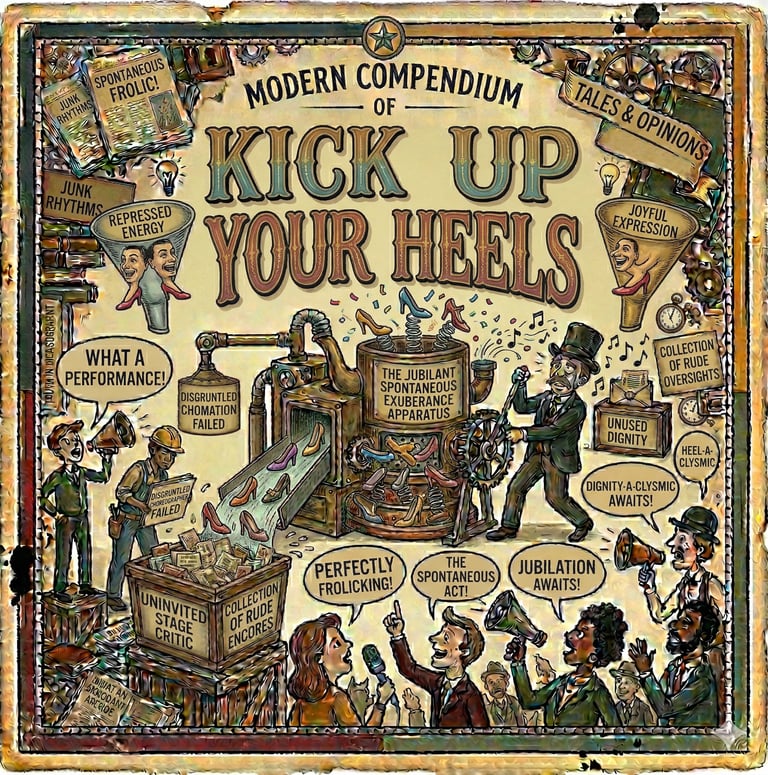
To relax, enjoy oneself, and have a lively, good time—often after a period of hard work or restraint. It implies a sense of carefree physical movement, like dancing or running, fueled by a sudden burst of freedom.
The Deep Dive
This is a literal piece of "junk knowledge" from the transition of the workhorse to the open pasture. Before the internal combustion engine, the "heels" of a horse were the most important mechanical parts of the agricultural economy.
The Working Frame: A horse in harness—whether pulling a plow or a carriage—is physically restricted. Its "heels" (the back of the hooves) are firmly planted or moving in a disciplined, rhythmic trot. The weight of the tack and the pressure of the bit keep the animal's energy focused and "low."
The Release: When the harness is removed and the horse is turned out into a field, it often experiences a "burst of spirits." It will gallop, twist its body, and literally kick its hind heels high into the air. This "bucking for joy" is the purest animal expression of being off the clock.
The Human Shift: By the mid-19th century, the phrase had moved to the ballroom and the tavern. To "kick up one's heels" meant to dance with such abandon that your feet (and heels) left the floor in a way that would be "improper" during a formal working day.
While some "junk" etymologists link the phrase to the "heels" of a corpse (suggesting it means to die, similar to "kick the bucket"), the overwhelming historical usage in American and British English is positive. It was a favorite idiom of Mark Twain, used to describe the rowdy, unburdened joy of the frontier.
Fast Facts
The "Cool Your Heels" Contrast: To "cool your heels" means the exact opposite—to be kept waiting and forced to remain still, usually as a sign of someone else's superior status.
The "Heel-and-Toe" Dance: In the 19th century, a "heel-and-toe" was a specific type of lively polka or step-dance that required the very action the idiom describes.
The First Print: The phrase appeared in English literature as early as the 16th century, originally meaning "to be tripped up" in a fight, but it evolved into its "celebratory" meaning by the early 1800's.
References
Twain, M. (1872). Roughing It. (On the exuberant life of the West).
Ammer, C. (2013). The Dictionary of Clichés. Skyhorse Publishing.
Flexner, S. B. (1982). Listening to America. Simon & Schuster.
The Oxford English Dictionary. (2026). Heel (n.1) and Kick (v.). Oxford University Press.