King’s Ransom
The Definition
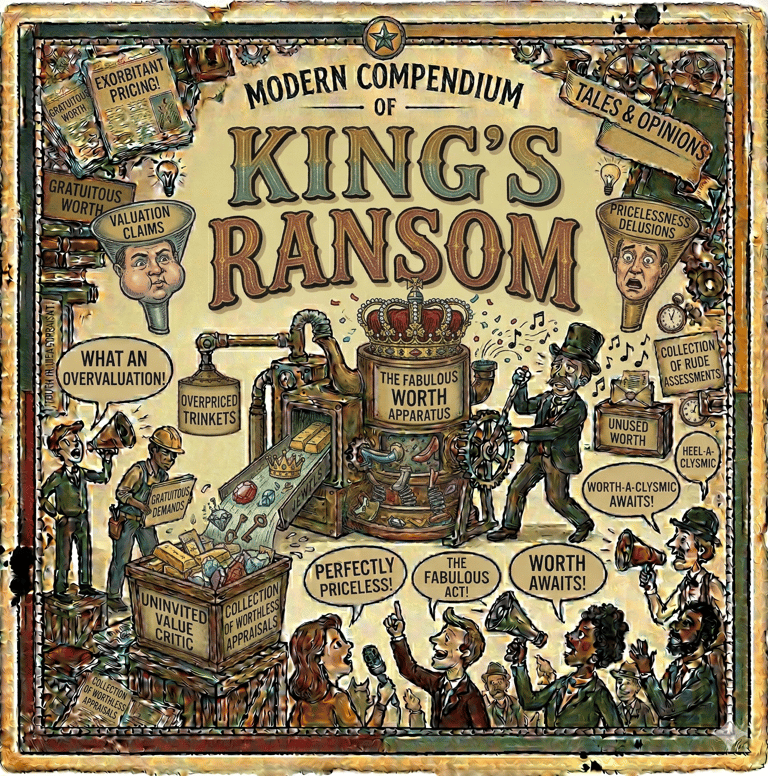
A huge, almost inconceivable sum of money. It describes a price tag so high that only the wealthiest individuals or entire nations could realistically afford to pay it.
The Deep Dive
This is a literal piece of "junk knowledge" from the high-stakes world of Medieval warfare. Before the Geneva Convention, war was a business as much as a political struggle. In the 12th and 13th centuries, a captured enemy soldier wasn't just a prisoner; they were a liquid asset.
The Ransom Economy: If a knight or nobleman was captured on the battlefield, the captor wouldn't necessarily kill them. Instead, they would "hold them to ransom." The higher the rank, the higher the price.
The Ultimate Asset: A captured King was the "jackpot" of the feudal era. The most famous "King's Ransom" in history belonged to Richard the Lionheart. In 1192, while returning from the Crusades, Richard was captured by Leopold V, Duke of Austria.
The "Junk" Reality of the Cost: The ransom set for Richard was 150,000 marks—roughly 65,000 pounds of silver. This was two to three times the entire annual income of the English Crown. To pay it, England had to be taxed into near-oblivion, with every clergyman and layman surrendering a quarter of their value and even the gold and silver church plate being melted down.
The phrase moved from a literal "invoice for a monarch" to a metaphorical "outrageous price" by the 16th century. Even after kings stopped being kidnapped for silver, the term remained the gold standard for describing anything—from a rare gemstone to a high-end luxury car—that costs "an arm and a leg" (another favorite idiom).
Fast Facts
The "Weight in Gold" Link: While the phrase "worth his weight in gold" is often used alongside a King's Ransom, Richard's ransom was actually calculated in silver, which was the primary currency of the Holy Roman Empire at the time.
The "Ransom" Word: The word comes from the Old French rançon, which itself is a variant of the Latin redemptio (redemption)—the act of buying back a soul or a body.
The First Print: The specific phrase "a king's ransom" was already well-established in English by the time of the Wycliffe Bible (1382) and was later used by Shakespeare in The Winter's Tale.
References
Gillingham, J. (1999). Richard I. Yale University Press.
Shakespeare, W. (1611). The Winter's Tale. (Act IV, Scene 4).
Ammer, C. (2013). The Dictionary of Clichés. Skyhorse Publishing.
The Oxford English Dictionary. (2026). Ransom (n.). Oxford University Press..