Kith and Kin
The Definition
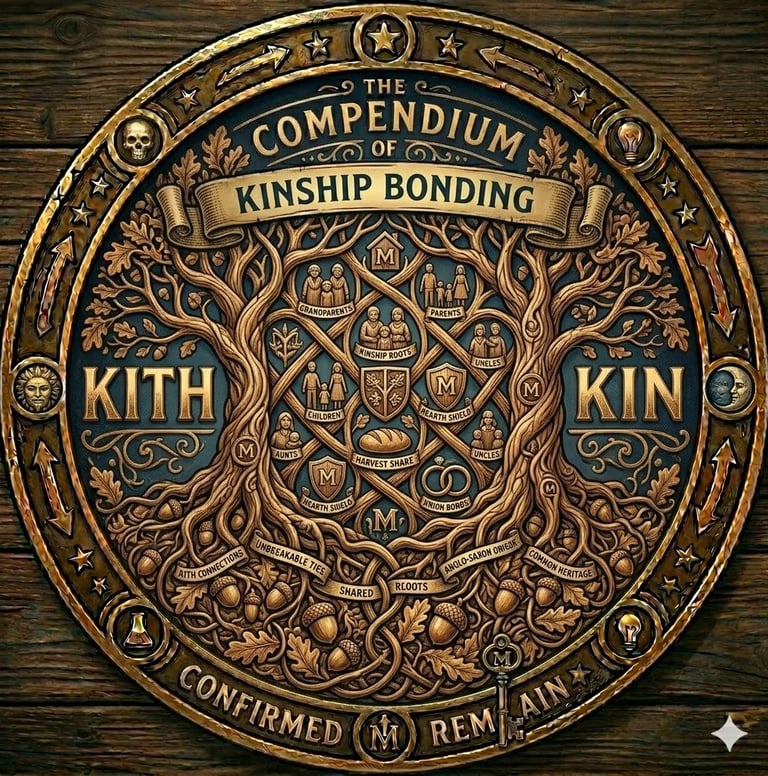
A traditional idiom used to describe one's friends, acquaintances, and family members. While today it is often used as a redundant way of saying "family," it historically distinguished between two distinct circles of social connection: those you know through choice and community (Kith) and those you are related to by blood (Kin).
The Deep Dive
The "junk knowledge" behind "kith and kin" is that the word "kith" has almost entirely died out in the English language except when it is being protected by its "kin." It is a "fossil word"—a term that survives only within a specific idiom.
The Original Meaning of Kith: In Old English, cythth (kith) meant "knowledge," "acquaintance," or "native land." It referred to the people you were familiar with—your neighbors, your fellow villagers, and your social network. To have "kith" meant you were a known member of a community, rather than a stranger or an outcast.
The "Kin" Connection: Kin comes from the Old English cynn, referring to family, race, or kind. While "kith" was about familiarity, "kin" was about biological lineage. In medieval society, your safety and legal standing depended on both: your kin defended you in blood feuds, while your kith provided the daily cooperation needed to survive in a village.
The Alliterative Trap: The phrase has survived since the 14th century largely because of alliteration. Humans have a "junk" preference for phrases where words start with the same sound (like "thick and thin" or "spick and span"). This rhythmic quality helped "kith" survive long after people stopped using it to mean "friends" in daily conversation.
The phrase reached peak "junk" status in the Victorian era, as it was revived by poets and novelists seeking to evoke a sense of "Olde England." It represents the "junk" of linguistic preservation: a word that we continue to say even though we’ve long since forgotten exactly what it means on its own.
Fast Facts
The Uncanny "Uncouth": The word "uncouth" is the direct linguistic descendant of the negative form of kith (uncuð). Originally, it didn't mean "rude"; it meant "unknown" or "unfamiliar." An "uncouth" person was simply a stranger—someone who wasn't part of your "kith."
The Legal Standing: In ancient Germanic and Saxon law, your "kin" were legally responsible for your crimes. If you committed a "kin-slaying," you lost your protection and became "kith-less," a status often resulting in exile or death.
Modern "Kin": While "kith" is a fossil, "kin" remains highly active in modern science, particularly in Kin Selection, an evolutionary theory that explains why animals (including humans) are more likely to perform self-sacrificing behaviors for those who share their DNA.
References
Oxford English Dictionary. (2026). Etymology of Kith and Kin.
Minsheu, W. (1617). Ductor in Linguas (The Guide into the Tongues).
Hamilton, W. D. (1964). The Genetical Evolution of Social Behaviour. Journal of Theoretical Biology.