Kleenex

The Definition
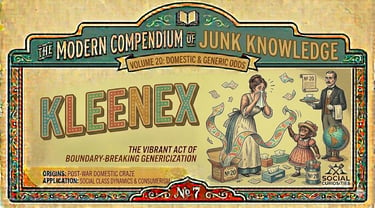
"Kleenex" is a proprietary eponym—a brand name that has become so synonymous with a product category that it is used to describe the product itself, regardless of who manufactured it. In this case, it refers to disposable paper facial tissues. It represents the success of a brand becoming the language of an entire industry.
The Deep Dive
The story of Kleenex is a classic example of a product finding its true purpose through consumer behavior rather than original intent.
The Wartime Roots: The material used in Kleenex, called Cellucotton, was originally developed during World War I as a substitute for cotton surgical dressings. It was highly absorbent and cheaper to produce. After the war ended, the Kimberly-Clark company had a massive surplus of this material and needed a "junk" application to keep the machines running.
The Makeup Mistake: In 1924, Kleenex was launched as a "sanitary cold cream remover." It was marketed to women as a way to wipe off makeup and facial cream without ruining expensive cloth towels. The name itself was a blend of "clean" (to highlight its function) and the "ex" suffix from the popular Kotex brand.
The Sneeze Pivot: Despite the makeup marketing, the company began receiving letters from customers who were using the tissues to blow their noses. They found it more hygienic than carrying around a reusable cloth handkerchief. In 1930, Kimberly-Clark shifted their entire marketing strategy to emphasize the "disposable handkerchief" angle. Sales doubled within a year.
Genericide Risk: Because the brand became so dominant, it faces the constant threat of "genericide"—a legal status where a trademark is lost because the public uses the name as a generic term (like "aspirin" or "escalator"). This is why the company often runs advertisements reminding people that "Kleenex" is a brand, not a tissue.
Fast Facts
The "Pop-Up" Innovation: In 1928, the company introduced the perforated "Pop-Up" box, ensuring that pulling one tissue would automatically present the next. This mechanical convenience helped cement its place on every nightstand and office desk.
The "Handkerchief" Rivalry: Before Kleenex, the fabric handkerchief was a status symbol. The rise of the disposable tissue signaled a major shift in public health awareness, moving away from carrying germs in one's pocket.
References
Kimberly-Clark Archives. (2024). The 100-Year History of the Facial Tissue.
Ammer, C. (2013). The Dictionary of Clichés. Skyhorse Publishing.
Oxford English Dictionary. (2026). Proprietary Eponyms and the Evolution of Modern Brands.