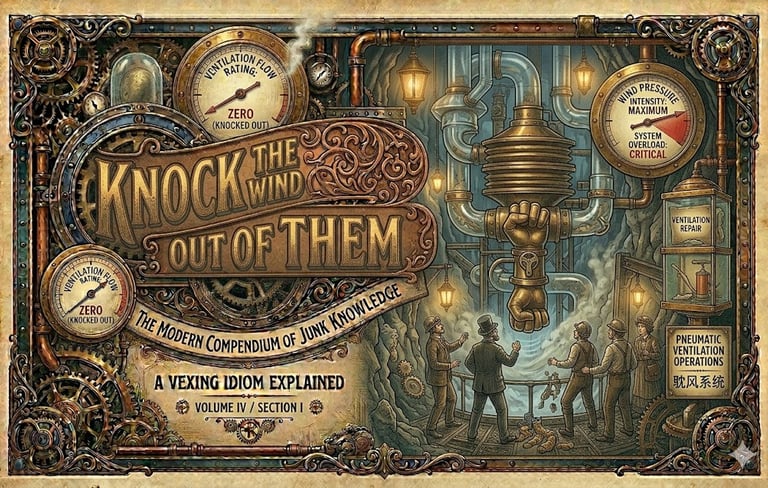
Knock the Wind Out of Them
The Definition
To "knock the wind out of someone" is to cause a sudden, temporary inability to breathe, usually as a result of a sharp blow to the abdomen or a sudden fall. Metaphorically, it describes a sudden shock, a piece of bad news, or a crushing disappointment that leaves a person momentarily stunned and unable to respond.
The Deep Dive
The phrase is rooted in the physiological reality of the human respiratory system, specifically the diaphragm.
The Solar Plexus: When a person receives an impact to the stomach area, the diaphragm—the muscle responsible for drawing air into the lungs—can undergo a sudden spasm. This prevents the lungs from expanding, causing a terrifying sensation of being unable to catch one's breath. In 19th-century medical and sports terminology, this was often called being "winded" or losing one's "bellows."
Nautical and Mechanical Influence: Before it became a common sports term, "knocking the wind out" was used in sailing. To "knock the wind out of a sail" meant to maneuver a ship so that its sails were shielded from the breeze by another vessel or an obstacle, causing them to go limp and the ship to lose momentum. This imagery of a sudden loss of power transferred perfectly to the physical experience of a person losing their breath.
Emotional Impact: By the early 20th century, the phrase moved beyond physical contact. It became a way to describe the effect of a psychological blow. Receiving news of a financial loss or a personal betrayal can feel like a physical strike to the gut, stopping a person's "momentum" and leaving them figuratively gasping for air as they try to process the new reality.
Fast Facts
The "Bellows" Comparison: Early English speakers often compared the lungs to a blacksmith's bellows. If the bellows were crushed or struck, the fire (life/energy) would momentarily flicker out.
Recovery Time: Physically, "having the wind knocked out of you" typically lasts only a few seconds to a minute, but the psychological version of the idiom can describe a setback that takes weeks or months to recover from.
References
Ammer, C. (2013). The Dictionary of Clichés. Skyhorse Publishing.
Oxford English Dictionary. (2026). The Physiology and Metaphor of Respiration in Victorian English.
Travers, B. (1924). The Art of Boxing and Self-Defense.