Lady Godiva Legend
The Definition
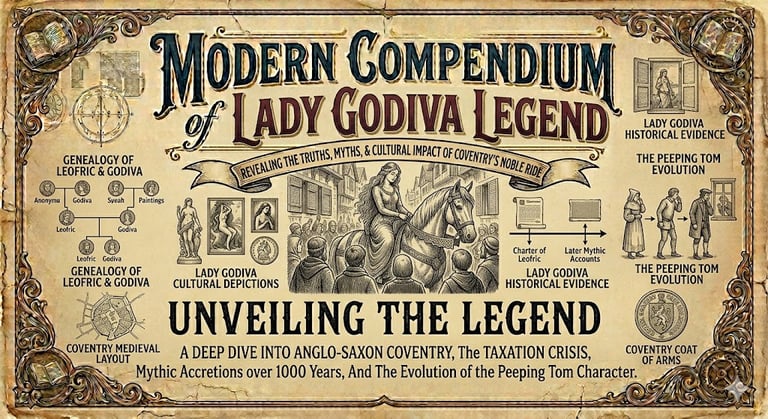
A famous medieval legend concerning an 11th-century Anglo-Saxon noblewoman, Godifu (latinized as Godiva), who purportedly rode naked through the streets of Coventry, England. According to the tale, she performed this act of radical transparency to persuade her husband, Leofric, Earl of Mercia, to lift an oppressive tax (the "heregeld") on his tenants.
The Deep Dive
The "junk knowledge" behind Lady Godiva is that the most famous part of the story—the nudity—was likely a medieval marketing invention added 200 years after she died. The real Godiva was one of the few female landowners in England and a powerful religious benefactor, not a public exhibitionist.
The Original Protest: In the earliest written accounts (c. 1236) by the monk Roger of Wendover, Godiva asks her husband to free the town from a heavy tax. Leofric, fed up with her nagging, mockingly replies, "Mount your horse, and ride naked, before all the people, through the market of the town from one side to the other, and on your return you shall have what you desire." He assumed her modesty would stop her.
The "Naked" Nuance: Historians suggest that if the ride happened at all, "naked" might have meant she rode without her jewelry, finery, or signs of rank—wearing only her plain white shift (an undergarment). In the class-conscious 11th century, a high-born noblewoman appearing in public in her "underwear" would have been a shocking act of humility, equivalent to being socially "naked."
The Peeping Tom Patch: The character of "Peeping Tom" wasn't added to the story until the 17th century. In this later version, Godiva sends out a herald ordering everyone to stay indoors and shutter their windows. A tailor named Tom bores a hole in his shutters to sneak a look and is instantly struck blind (or dead) by divine intervention.
The legend reached peak "junk" status in the Victorian era, as artists obsessed over the contrast between her scandalous nudity and her saintly intentions. It represents the "junk" of historical branding: how a powerful, pious woman’s life work was reduced to a single, likely fictional, "streaking" incident that now sells premium chocolates.
Fast Facts
The Real Godiva: Unlike many legends, Godiva was a real person. She and Leofric founded the Benedictine monastery in Coventry in 1043. She is one of the only English women mentioned in the Domesday Book (1086) as a major landowner.
The "Heregeld" Tax: The tax she was supposedly protesting was the heregeld, a tax used to pay for the King's mercenary army. It was indeed a crushing burden for the poor, making Godiva a legitimate folk hero for tax resistance.
The Coventry Procession: Starting in 1678, the city of Coventry began holding a "Godiva Procession" as part of its annual fair. This tradition continues today, featuring a "Godiva" on horseback, though modern versions usually involve a bodysuit.
References
Donoghue, D. (2003). Lady Godiva: A Literary History of the Legend. Blackwell Publishing.
Roger of Wendover. (c. 1236). Flores Historiarum (Flowers of History).
The Herbert Art Gallery & Museum. (2026). The Godiva Collection: Myth and Reality.