Lame Duck
The Definition
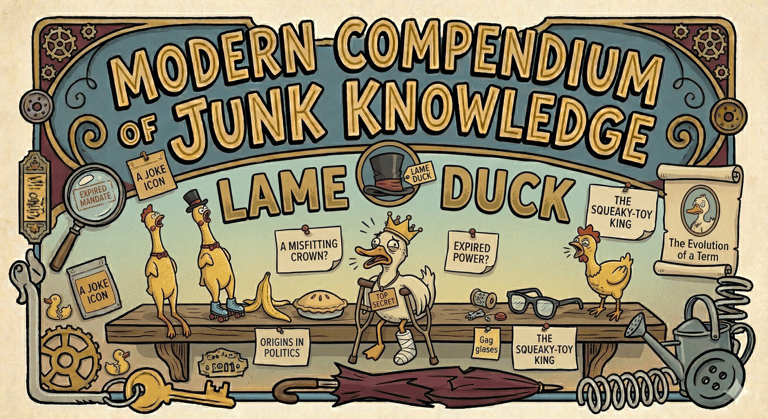
An official (usually a politician) who is still in office but has not been re-elected, or is serving out a final term after a successor has been chosen. It describes a period of diminished power and influence, where the official is "hobbled" by their impending departure.
The Deep Dive
The "junk knowledge" behind the "lame duck" is that it didn't start in the halls of government, but in the frantic pits of the 18th-century London Stock Exchange. Before it was a political metaphor, a "lame duck" was a bankrupt stockbroker who could not pay his debts.
In the 1760's, if a broker "waddled out of the Alley" (Exchange Alley) because they defaulted on their accounts, they were mocked as a "lame duck." The image was of a bird that had been injured and could no longer keep up with the flock, making it a target for predators.
The Financial Failure: Being a "lame duck" was a mark of professional shame. It meant you were still physically present in the financial district but lacked the "legs" (capital) to make any further trades.
The Political Migration: The phrase crossed the Atlantic and migrated into American politics in the mid-19th century. It was famously used to describe President James Buchanan during the four-month gap between Abraham Lincoln's election and his inauguration. Because Buchanan was leaving and could not be held accountable by voters, he was seen as a "duck" that could no longer fly or fight.
The status was so problematic for the U.S. government—often leading to months of legislative paralysis—that it resulted in the 20th Amendment to the Constitution in 1933. Known as the "Lame Duck Amendment," it moved the presidential inauguration from March to January, effectively shortening the "waddle" of the outgoing administration.
Fast Facts
The 20th Amendment: Before 1933, a "lame duck" Congress would sometimes meet for an entire session after an election, passing laws even though many members had already been voted out.
The British Variant: In the UK, the term is less common in politics; they prefer the term "caretaker" or simply "outgoing," though the "lame duck" remains a staple of American news cycles.
The Literal Origin: In actual hunting lore, a "lame duck" is a bird that has been "winged"—it isn't dead, but it can no longer fly with the formation, making it a "sitting duck" for the next shot.
References
Constitutional Convention. (1933). The 20th Amendment to the U.S. Constitution.
Ammer, C.. (2013). The Dictionary of Clichés. Skyhorse Publishing.
Safire, W.. (2008). Safire's Political Dictionary. Oxford University Press.
The Oxford English Dictionary.. (2026). Duck (n.). Oxford University Press.