Lava Lamp
The Definition
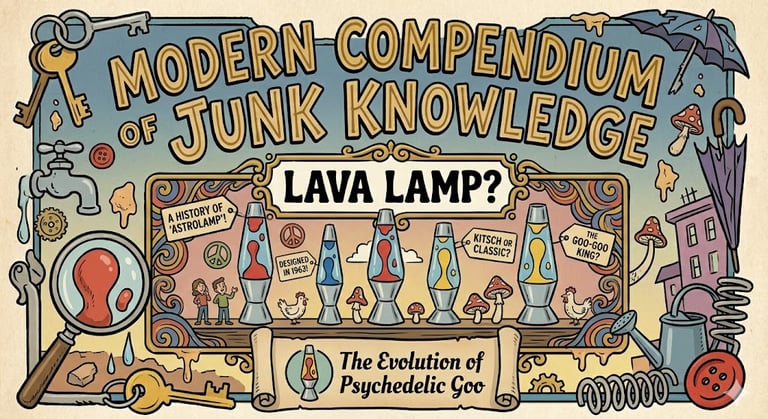
A decorative novelty lamp containing a translucent liquid and a colorful, waxy compound that rises and falls in undulating, amoeba-like shapes. Heated by an incandescent bulb at the base, it is the quintessential symbol of 1960's psychedelia and remains the world’s most famous example of "kinetic lighting."
The Deep Dive
The "junk knowledge" behind the Lava Lamp is that it began as a humble British egg timer. In 1948, an ex-RAF pilot and accountant named Edward Craven Walker was sitting in a pub in Dorset, England, when he spotted a strange, homemade device on a stove: a cocktail shaker filled with bubbling liquids. It had been designed by a man named Donald Dunnet (who had since passed away) to tell when an egg was perfectly boiled.
The 15-Year Perfection: Craven Walker bought the rights to the idea but spent the next 15 years trying to refine the formula. The challenge was finding two liquids with the exact same density that wouldn't mix—one that would expand and become lighter than the other when heated, then cool and sink.
The "Astro" Launch: In 1963, he finally launched the "Astro Lamp." Initially, he didn't market it to hippies; he pitched it as a luxury executive desk toy. Early advertisements featured the lamp in wood-paneled offices next to ballpoint pens and cigars, marketed as a "motion for every emotion."
The American Takeover: In 1965, two American entrepreneurs, Hy Spector and Adolph Wertheimer, saw the lamp at a German trade show and were mesmerized. They bought the U.S. rights, renamed it the Lava Lite, and moved production to Chicago. By the time the "Summer of Love" hit in 1967, the lamp’s swirling, hypnotic motion perfectly matched the psychedelic aesthetic of the era.
The Lava Lamp reached peak "junk" status in the late 1960's, selling over seven million units a year. It represents the "junk" of sensory physics: a liquid-motion display that was eventually adopted by the counterculture as a "trip" in a bottle. It is one of the few products that went from a buttoned-up executive accessory to a stoner staple without changing its design.
Fast Facts
The Secret Formula: The "lava" is actually a mixture of paraffin wax and other chemicals (like carbon tetrachloride in older models) to adjust density. The liquid is usually water and antifreeze (propylene glycol).
The Ringo Factor: Craven Walker knew the lamp had hit the big time when he heard that Ringo Starr had purchased one. From that point on, it became a mandatory prop for British sci-fi, appearing in early episodes of Doctor Who.
The "Mathmos" Name: The original British company, Crestworth, was renamed "Mathmos" in the 1990's. The name is taken from the 1968 cult film Barbarella, referring to the bubbling, molten lake of evil beneath the city of Sogo.
References
Mathmos Heritage. (2026). The History of the Astro Lamp.
Craven Walker, E. (1963). GB Patent No. 703924: Improvements in Display Devices.
Smithsonian Magazine. (2026). The Groovy Science of the Lava Lamp.